

Founders who get it
Our founders built products. We understand the pressure you're under and the trade-offs you're making.
Your idea deserves more than a pitch deck. We build MVPs that attract users, convince investors, and give you real data to make decisions — not guesses. Go from concept to working product in 8-12 weeks.
Oleg Kalyta
Founder & AI Lead
Free Discovery
Validate your idea, no commitmentDesign & Plan
Wireframes and technical specsMVP Launch
Production-ready productBuilding an MVP comes with real obstacles. Here's what we help founders get past.
You've spent months on a business plan but have nothing to show investors
Ship a working product. Investors fund traction, not slide decks.
Your technical co-founder left, or you never had one
We become your CTO. Architecture decisions, technical strategy, execution - handled.
You're not sure which features to build first
One core user flow. Everything else is a distraction until that works.
Previous developers delivered a mess that can't scale
We audit, decide what's salvageable, and fix it. You get code that grows with you.
You're burning through runway without clear progress
Weekly demos, bi-weekly sprints. You see working software, not status updates.
Ship faster, learn faster, grow faster
Validate before you invest
Test your core assumptions with real users before committing to full development. Learn what works and what doesn't with actual data.

Attract investors with traction
A working product with real users speaks louder than any pitch deck. Show investors you can execute.

Get to market faster
While competitors are still planning, you're shipping. Speed is your competitive advantage.

Minimize financial risk
Spend $40-70K to learn what works instead of $200K+ on a product nobody wants.

End-to-end MVP development services covering the entire product lifecycle, from idea validation to launch and beyond.
Before writing a single line of code, we help you validate your startup idea with market research, competitor analysis, and user interviews. Our discovery phase includes feature prioritization using the MoSCoW method, technical feasibility assessment, risk identification, and realistic timeline planning. You walk away with a clear product roadmap and confidence that you are building something users actually want.
Great products start with great design. Our design sprint process takes you from concept to clickable prototype in days, not weeks. We create user flows, wireframes, and high-fidelity mockups that you can test with real users before development begins. This approach catches usability issues early and ensures your MVP launches with a polished, professional experience.
We build production-ready MVPs using modern tech stacks: React Native for mobile, React/Next.js for web, Node.js/NestJS for backend, and PostgreSQL or MongoDB for data. Our Agile process includes weekly demos, continuous deployment to staging, comprehensive documentation, and architecture designed to scale. You get a real product, not a throwaway prototype.
Launch with confidence. Our QA team performs functional testing, device compatibility checks, performance testing, and security audits. We handle the entire launch process: production deployment, App Store and Google Play submissions, analytics integration (Mixpanel, Amplitude, or custom), and crash reporting setup. Includes 30 days of bug fixes post-launch.
Your MVP is just the beginning. As you gather user feedback and prove product-market fit, we help you scale. Our post-launch services include feature expansion based on user data, performance optimization, infrastructure scaling, technical debt management, and roadmap planning. Ready for the next stage? Explore our full-cycle product development services.
Differentiate your MVP with AI capabilities. We integrate ChatGPT and other LLMs for intelligent chatbots and content generation, build recommendation engines that personalize user experiences, implement computer vision for image recognition, and create predictive models for forecasting. Our AI solutions are production-ready with proper error handling, cost optimization, and monitoring.
Real MVPs. Real funding. Real users. See how we've helped founders go from idea to traction.

AI-Powered Health Companion
We built an AI health app from concept to launch in 10 weeks. The app integrates Apple HealthKit, processes data with OpenAI and LangChain, and delivers personalized wellness recommendations through a multi-agent AI system.

Gaming Trading Platform
Built web and mobile platform with real-time trading, user profiles, and community tools. Scaled to become the #1 trading platform for Rocket League globally.

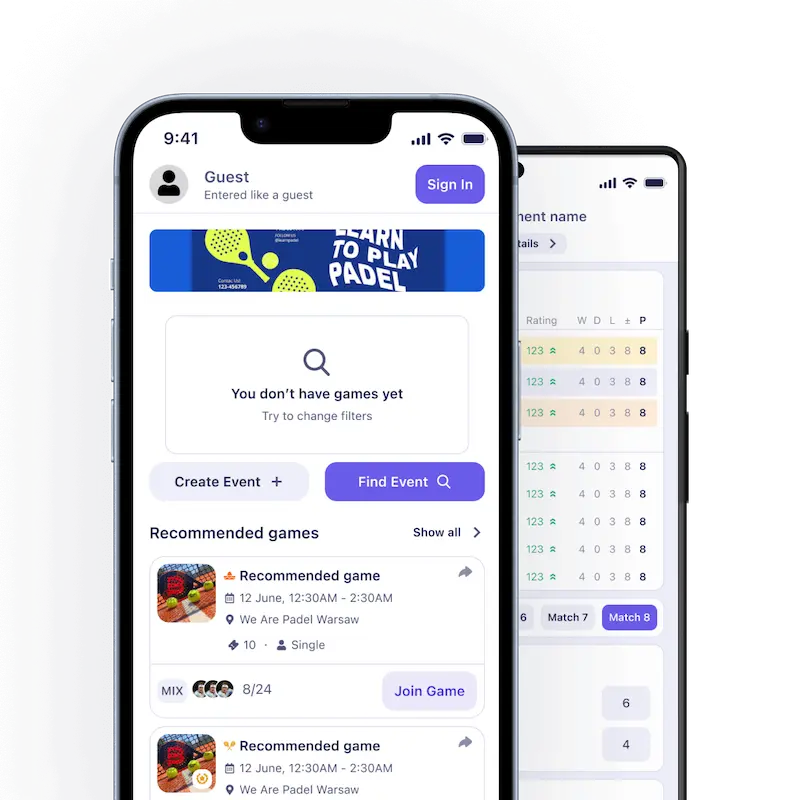
Tournament Management App
Mobile app for players and web dashboard for club managers. Booking, brackets, scoring, and Stripe payments integrated.
Different products need different approaches. We match the MVP format to your business model and market.
A browser-based product you can launch without app store approvals. Web MVPs work across all devices, are easier to update, and let you iterate based on user feedback without waiting for review cycles. Best for B2B products, SaaS tools, marketplaces, and anything where fast iteration matters more than native mobile features. See how we built Breeze, a German real estate platform that matches tenants with landlords across web and mobile.
Native iOS or Android apps built with just the core features needed to prove your concept. We typically use React Native for cross-platform development, which means you get both platforms from one codebase. Mobile MVPs make sense when your product needs push notifications, camera access, GPS, or offline functionality. Rocket League Garage started as a simple MVP and grew to 6M+ users, becoming the #1 trading platform for the game globally.
Subscription-based software delivered through the browser. SaaS MVPs need solid authentication, billing integration (usually Stripe), and often multi-tenant architecture from day one. We build these to scale, because if your SaaS works, you'll have paying customers fast and need infrastructure that can handle growth. Our EvLuv platform now manages 65K+ charging stations with enterprise-grade reliability.
Products that use machine learning, LLMs, or computer vision as core features. We integrate OpenAI, Claude, or custom models depending on your use case. The challenge with AI MVPs is managing costs and latency while still delivering a great user experience. Healify, our AI health companion, raised $2M in funding just 6 months after we started building it together.
Two-sided platforms connecting buyers and sellers, service providers and customers, or any supply-demand relationship. Marketplace MVPs are tricky because you need both sides to see value. We usually recommend starting with one side manually while building the other, then automating as traction grows. Rocket League Garage solved the chicken-and-egg problem by focusing on traders first, then expanding to buyers.
Software that pairs with physical devices, IoT sensors, or wearables. These MVPs need to handle Bluetooth/WiFi connectivity, data syncing, and often work offline when devices lose connection. EvLuv connects to EV charging stations via OCPP protocol, handling real-time status updates, payments, and station management across thousands of devices.
Modern, battle-tested tech stack for startups that need to move fast and scale later


Business analysis & requirements gathering. We dig into your business model, target users, and competitive landscape to understand exactly what needs to be built.
We design the architecture, create wireframes, and plan the development sprints. You'll see and approve the approach before we write a single line of code.
Coding, APIs, data pipelines. Bi-weekly sprints with demos every two weeks. You see progress constantly and can adjust based on what you learn.
Performance & scalability testing. We ensure your MVP handles real-world usage, optimize load times, and fix any issues before launch.
Monitoring & updates. We deploy to production, set up analytics, and provide ongoing support to help you iterate based on real user feedback.
Get a free consultation to discuss your MVP scope, timeline, and budget.
We've shipped MVPs across every major startup vertical. Industry experience matters because it means faster development, fewer surprises, and architecture that fits your market.
Payment apps, lending platforms, investment tools, and banking alternatives. We understand PCI compliance, KYC/AML requirements, and what it takes to get through fintech-specific investor due diligence. Finsu, our financial planning app, handles complex calculations and regulatory requirements while keeping the UX simple enough for everyday users.
Patient apps, telehealth platforms, wellness tools, and clinical software. HIPAA security features are built in from the start, not bolted on later. Healify raised $2M in funding within 6 months of launch - we took it from idea to App Store in 10 weeks.
Two-sided platforms for services, products, or talent. The chicken-and-egg problem is real - we help you solve it with scrappy launch strategies, not just code. Rocket League Garage grew to 6M+ users by starting with traders first, then expanding to buyers.
Mobile-first products where engagement and retention are everything. We obsess over onboarding flows, push notification strategy, and the small details that turn downloads into daily active users. FunPadel now operates in 6+ countries with thousands of tournament bookings.
Property management, real estate marketplaces, and construction tech. These markets move slower but deal sizes are larger. Breeze matches tenants with landlords across Germany, handling the complexity of real estate transactions in a simple mobile experience.
Route optimization, warehouse management, and delivery tracking. Logistics MVPs often need real-time location data, complex state management, and integrations with existing systems. EvLuv manages 65K+ EV charging stations with real-time status updates and payment processing.
What most impressed me about ProductCrafters was their dedication to my project and understanding of our goals. They were very honest and transparent throughout the entire process.
They were flexible, and it was easy to work with them on a day-to-day basis. Their brilliant ideas were critical to the project success.

Out of over 40 applicants, we selected ProductCrafters based on their experience, technical expertise, and cost estimate. The team showed deep technical expertise, a strong work ethic, and honesty.

The team has honest billing practices and creates incredible value for the cost. Working with ProductCrafters has saved us hundreds of thousands of dollars compared to domestic firms.

The quality of their code makes them a valuable partner. They thought holistically about solutions and brought up all-encompassing ideas.

Their insightful advice has maximized the application's performance. We're actually learning things from ProductCrafters that we can adapt and use in other applications.

Customer stories

We're not just developers. We're founders who've been through it ourselves.

Our founders built products. We understand the pressure you're under and the trade-offs you're making.

We'll tell you if your timeline is unrealistic or your scope is too big. Better to hear it now than after you've spent months and money.

The developers you meet are the developers who build your product. No juniors, no offshore handoffs, no surprises.

We architect for growth from day one. When you raise that Series A, you won't need to rebuild from scratch.

We have process, continuity, and backup. If someone gets sick, your project doesn't stop. We've been doing this for 8+ years. Meet the team.
Transparent pricing based on complexity. Every project includes discovery, design, development, and 30 days of post-launch support.
6-8 weeks
$10,000 – $25,000
8-12 weeks
$25,000 – $50,000
12-16 weeks
$50,000 – $100,000

Free Discovery
Validate your idea, no commitmentDesign & Plan
Wireframes and technical specsMVP Launch
Production-ready product
Oleg Kalyta
Founder & AI LeadAfter building dozens of MVPs, we've seen clear patterns in what works and what doesn't. Here's what separates MVPs that gain traction from ones that stall.
The best MVPs do one thing that makes users say 'finally, someone built this.' Dropbox didn't launch with collaboration features - it was just a folder that synced. Stripe was just a payment form. Pick your one thing and nail it.
We've seen startups spend $100K building something nobody wanted. The fix is embarrassingly simple: talk to potential users before you write code, show them prototypes during development, and watch them use the product after launch. Most problems become obvious when you watch someone struggle.
Downloads don't matter if users churn after day one. Signups don't matter if nobody activates. We help you define the metrics that actually indicate product-market fit: retention, engagement, willingness to pay. These are what investors care about too.
There's a difference between 'MVP' and 'broken prototype.' Your MVP should be limited in scope, not limited in quality. Users forgive missing features. They don't forgive bugs, slow load times, or confusing interfaces. We build MVPs that feel polished even when they're minimal.
The worst outcome isn't failure - it's success you can't handle. We architect MVPs so that when you get featured in TechCrunch or close your first enterprise deal, the product doesn't fall over. Scaling problems are good problems, but only if you're ready for them. When you're ready to scale, our full-cycle product development takes you from MVP to market leader.
An MVP isn't a budget version of your product - it's a strategic tool for learning. Here's how they compare.
| Aspect | MVP Approach | Full Product | Why It Matters |
|---|---|---|---|
| Timeline | 6-12 weeks to launch | 6-12 months (or more) to launch | Every month you spend building is a month you could be learning from real users. |
| Investment | $25K-$70K typical range | $150K-$500K+ before launch | Spending less upfront means you can afford to be wrong and pivot without catastrophe. |
| Feature Scope | Core user flow only | Complete feature set | Most features you think are essential turn out to be nice-to-haves once you talk to users. |
| Risk Profile | Learn fast, fail cheap | High stakes, harder to pivot | The goal is to validate assumptions, not build your dream product on day one. |
| Architecture | Scalable but focused | Enterprise-grade from start | We don't write throwaway code, but we also don't over-engineer for problems you don't have yet. |
Every month you spend building is a month you could be learning from real users.
Spending less upfront means you can afford to be wrong and pivot without catastrophe.
Most features you think are essential turn out to be nice-to-haves once you talk to users.
The goal is to validate assumptions, not build your dream product on day one.
We don't write throwaway code, but we also don't over-engineer for problems you don't have yet.
We've watched startups make the same mistakes over and over. Most are avoidable if you know what to look for.
The number one killer of MVPs is scope creep. 'Just one more feature' turns into six months of development and a product that's too complex for users to understand. We're religious about cutting scope - it's not about what you could build, it's about what you need to learn.
Using Kubernetes because Google does, or Rust because it's trendy, or microservices because Netflix uses them. You're not Netflix. We pick boring, proven technology that lets us ship fast and won't require a platform team to maintain. React, Node, PostgreSQL - simple, effective, scalable.
Bad UX kills MVPs faster than missing features. Users will forgive a product that doesn't do everything - they won't forgive one that's confusing to use. We include real design work in every MVP, not just developer mockups.
Launching without tracking is flying blind. You need to know where users drop off, what features they actually use, and whether they come back. We set up analytics before launch, not as an afterthought.
An MVP is a tool for learning, not a finished product. The goal is to gather data that informs your next decisions. If you launch and then stop iterating, you've wasted the opportunity. Plan for what comes after launch.
Confirmation bias is real. When users tell you your product is confusing or unnecessary, listen. The market doesn't care about your vision - it cares about its problems. Be willing to pivot based on what you learn.
Every week you wait is a week your competitor gets ahead. Let's turn your concept into a product users love.