



AI agents are no longer just a futuristic concept — they’re rapidly becoming a core part of how businesses operate. According to multiple industry surveys, over half of companies (51 %) have already deployed AI agents in real work environments, and another 35 % plan to adopt them within the next two years, signaling a shift from pilot projects to strategic integration. Meanwhile, broader AI adoption statistics show that 78 % of organizations now use AI in at least one business function, with many leaders betting on agentic systems to automate workflows and augment human teams.
These trends make it clear that understanding the different types of AI agents, from simple reflex models to complex multi-agent systems, is no longer just technical theory but a growing business imperative.
Table of Contents
AI Agents: What They Are, and How They Work
Instead of waiting for explicit instructions, AI agents actively observe their environment, interpret what’s happening, and take action on their own. Unlike traditional software that follows static rules, an AI agent can respond to change, handle uncertainty, and adapt its behavior in real time. In practice, this makes an AI agent feel less like a passive tool and more like a digital colleague that can support teams, execute tasks, and make decisions as situations evolve.
So, at the highest level, how do AI agents work? Essentially, it’s a simple loop:
- They receive data from various sources, including emails, system events, documents, and the like.
- They use rules, models, or machine learning to make sense of that context.
- They decide on an action, and that decision is based on what they’ve learned or observed so far.
- Then they put that decision into action, which might involve updating a system, generating a report, making a prediction, or initiating a workflow.
The result of all this is that AI agents are fundamentally different from the traditional automation tools people are used to. Instead of being stuck with rigid, pre-defined scripts, an agent can handle uncertainty, weigh up all the options, and change its approach as it goes along. That flexibility is why businesses from all over, including marketing, operations, HR, logistics, and finance, are checking out agentic AI as a way to boost productivity without having to rip everything up and start again.
If your team has ever thought to themselves, “It would be great if this bit of our workflow just sort of happened automatically”, then an AI agent is often just the ticket.
The Various Types of AI Agents
Artificial Intelligence (AI) agents come in a few different forms, and each type lends itself to a different level of autonomy and decision-making. On one end of the spectrum, you have AI agents that are restricted to following a series of predefined rules, while on the other end, you have agents that can learn from their experiences, plan ahead, or collaborate with other agents to find solutions to more complex problems. When all these elements come together, they allow a business to automate processes that would normally require constant human supervision.
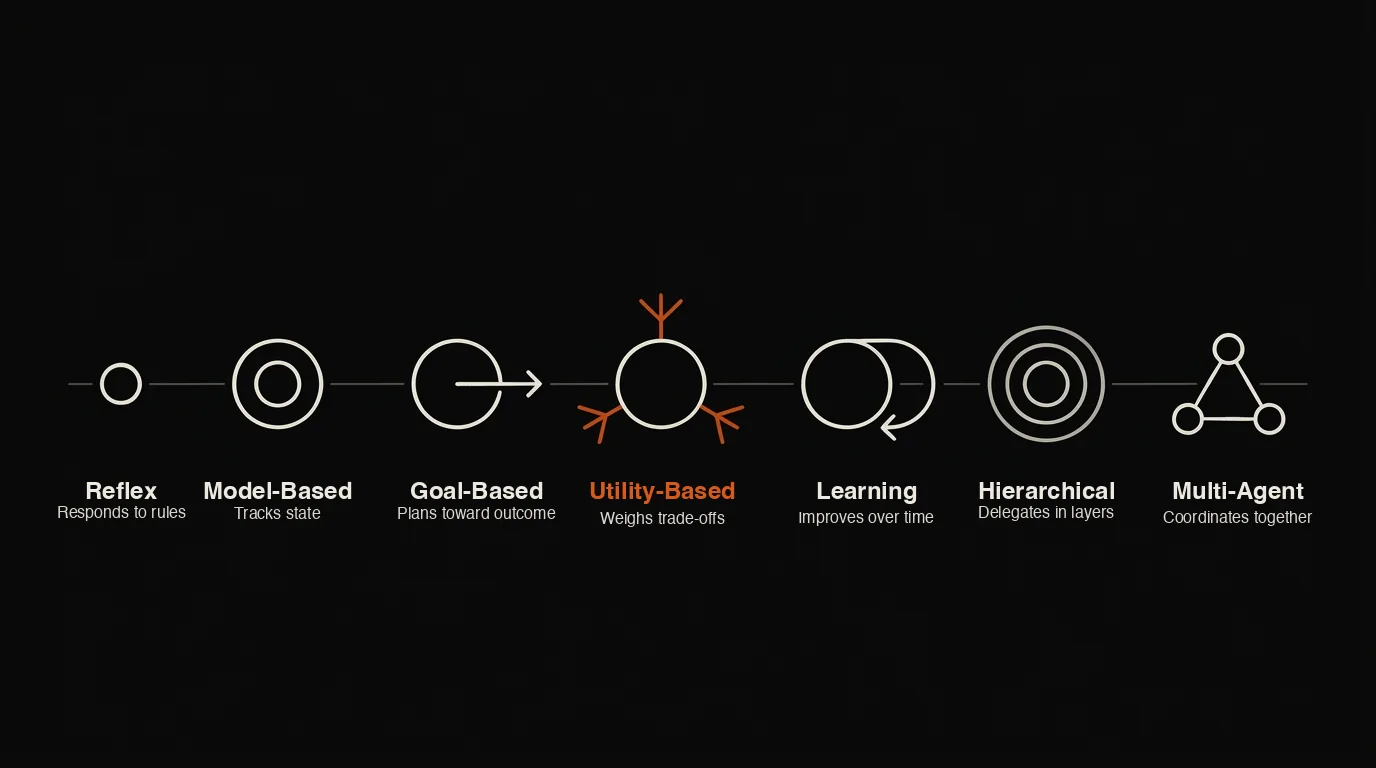
Below are the seven main types of AI agents that can be found in modern systems.
1. Simple Reflex Agents
Simple reflex agents operate based on straightforward “if–then” rules, reacting only to current inputs. They do not store previous information or consider long-term effects, making them fast and consistent but limited to predictable environments where extra context is not needed.
Some Examples:
- Basic automated responses to common questions
- Automated heating or cooling systems
- Single sensor alerts
They’re easy to put into place and maintain, but their simplicity means that they fall short when the environment starts changing too frequently.
2. Model-Based Reflex Agents
Model-based reflex agents add an internal model, so they not only use current inputs but also past data to update their knowledge of the environment. This lets the AI agents handle situations with incomplete information, distinguishing them from simple reflex agents that cannot manage such gaps.
Used in a number of areas:
- Systems that rely on historical data, like customer profiles
- Real-time monitoring of production
- Automated defect detection in manufacturing
This added context improves their accuracy and makes model-based agents more reliable than simple reflex agents, especially in complex, dynamic scenarios.
3. Goal-Based Agents
Goal-based agents move beyond simple reactions. Instead of responding to whatever is happening in the moment, they look ahead, weigh their options, and pick the next step that gets them closer to a specific outcome. This makes goal-based agents useful in situations where a task has several stages or where conditions might shift while the work is still in progress.
Teams often rely on them for things like:
- routing and re-routing deliveries
- scheduling and rescheduling tasks
- coordinating multi-step workflows that span several tools or departments
They stay effective even when the plan changes halfway through, because they can reassess the situation and adjust the path forward. As companies automate more of their operations, this flexibility becomes especially valuable.
4. Utility-Based Agents
Utility-based agents look at problems through another lens. They do not just try to reach a goal; utility-based agents try to reach the best possible version of it. When several options all lead to the same end-point, these agents compare the trade-offs, like cost, time, risk, customer impact, resource use, and choose the option that delivers the highest overall value.
You will see this approach in:
- portfolio or investment optimization
- real-time pricing models in e-commerce
- fleet management that balances fuel, travel time, and potential delays
Because most business decisions involve compromises, not simple yes-or-no answers, utility-based agents tend to be one of the most practical choices for teams managing competing priorities.
5. Learning Agents
Learning agents don’t just sit there. Instead, they’re always evolving. As they get their hands on new data and fresh feedback or encounter situations they haven’t seen before, they refine how they work. They compare outcomes, try out different approaches, and gradually tweak their methods, meaning they don’t get stuck repeating the same old behavior forever. This makes them pretty useful in environments where change is a constant and old rules stop being relevant the moment they’re made.
You’ll often see learning agents in scenarios like:
- fraud detection: where new patterns pop up left, right, and center
- recommendation systems that have to keep up with changing user tastes
- predictive maintenance that can spot early warning signs in machine behavior
Over time, and with good data to boot, a learning agent starts to get the hang of things becoming sharper, faster, and more reliable. The more it learns, the less it needs someone looking over its shoulder.
6. Hierarchical Agents
Hierarchical agents tackle complexity by breaking it down into manageable bits. They create a clear top-down structure, where the top layer is all about direction and overall strategy, and the lower layers are responsible for the nitty-gritty details needed to bring that strategy to life. It’s not dissimilar to how large teams work in the real world, when the leadership sets the plan, and the specialists execute the details.
You’ll find this sort of structure useful in areas such as:
- supply chain planning, where decisions are all interlinked
- enterprise workflow automation, especially in big organizations
- advanced manufacturing setups with loads of moving parts
By dividing up responsibility like this, companies can get more seamless coordination and fewer bottlenecks when everything needs to move at once.
7. Multi-Agent Systems
A multi-agent system places several agents in the same environment so they can interact and handle tasks collectively. In some situations they collaborate, in others they coordinate or negotiate responsibilities, and in more advanced setups they operate independently while pursuing aligned objectives. The key advantage is that the workload doesn’t fall on one agent alone. By distributing tasks and decision-making, the system can address problems that would be too complex or inefficient for a single agent to manage.
Some examples of this in action include:
- delivery robots coordinating their routes so they don’t all end up trying to squeeze down the same street
- financial simulations where multiple agents model different market behaviors
- customer support systems that can pass context between channels without losing a single piece of information
As businesses start to get more of their operations connected up, these multi-agent set-ups have started popping up in all sorts of places people might not have expected. Many companies have found out that one agent can be helpful, but having multiple agents working together can unlock a whole new level of efficiency.
Two Ways to Understand AI Agents
AI agents differ not just in what they do, but in how they are built and how they interact with the world. One useful way to think about them is by looking at their functional types, from simple reflex agents and retrieval agents to planning agents, multi-agent systems, and autonomous learners. These types capture the core capabilities — such as whether an agent reacts to inputs, plans multiple steps ahead, optimizes choices, or collaborates with others to solve complex tasks.
There’s also another dimension worth considering: how much independence and decision-making autonomy an agent has. This is where the concept of levels comes in, ranging from basic reactive behavior to systems capable of weighing options and optimizing across many variables.
It isn’t just analysts saying this — Gartner’s Top 10 Strategic Technology Trends for 2026 highlights agentic AI as a key trend shaping enterprise technology, where systems increasingly plan and act to achieve goals with limited human direction.
Understanding both types and levels helps organizations choose the right kind of agent for the task at hand and set realistic expectations before jumping into implementation.
The Four Levels of AI Agents
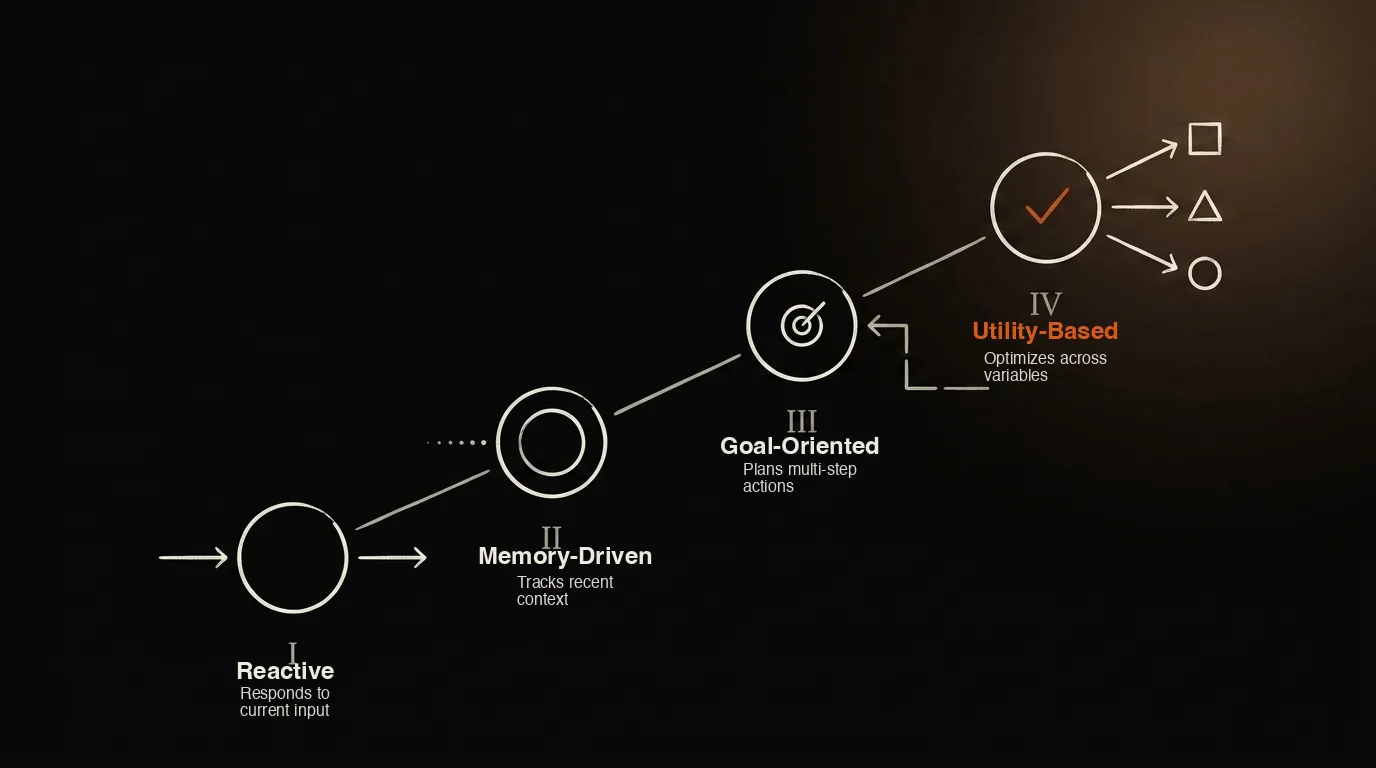
Not all AI agents do things the same way. AI agents vary widely in how much autonomy and planning capability they have. Knowing where your AI agent sits on this scale can save you from buying a fancy new system when what you really need is something with a bit more brain.
Level 1:
These agents react to what you say right now, like a bit of a knee-jerk response. They don’t remember much and don’t plan ahead. Basically just a little ‘yes/no’ type response. You see this in stuff like automatic safety systems and the simplest of chatbots.
Level 2:
They remember a bit more and can keep track of what’s going on for a short while, but they still aren’t really planning anything. A bit like a smart security system or tool that watches for network problems, but not looking too far ahead.
A Reality Check
A lot of those early-stage AI products end up being pretty basic, even when they’re marketed as super-smart. There was this big analysis from 2025 that claimed loads of startups were basically just taking ChatGPT or Claude and sticking it in a fancy new interface. Now, whether that number is right or not, the point is it’s easy to get sold on the packaging and miss the fact that it’s just a chatbot in disguise. Good to know what you’re actually getting before you rely on it.
Level 3:
Here, the agent can start to plan things out and figure out the steps they need to take to reach a goal. It can adapt to changes, too. Warehouse robotics and recommendation engines are usually built around this level.
Level 4:
These agents look at loads of different options and pick the one that makes the most sense. They’re built for real-world complexity and stuff like pricing, routing, scheduling, and working across teams – anything that involves loads of different variables.
A Quick Comparison Guide
| AI Agent Level | How It Operates | Typical Agent Types | Common Business Use Cases |
|---|---|---|---|
| Level 1 – Reactive | Immediate response, no memory | Simple reflex agents | Safety triggers, basic automation |
| Level 2 – Memory-Driven | Keeps short-term state | Model-based reflex agents | Smart security, monitoring tools |
| Level 3 – Goal-Oriented | Plans steps to reach goals | Goal-based and learning agents | Robotics, recommendations |
| Level 4 – Utility-Based | Weighs options and optimizes | Utility-based, hierarchical, multi-agent systems | Pricing, routing, smart factories |
When you start to put the level and type together, you get a clearer picture of what your AI can actually do. The lower levels are good for routine tasks and quick reactions, but the higher levels are where it’s at when you need to plan, optimize, and deal with more complicated stuff. Getting your head around this helps you set realistic expectations for what your AI can do, pick the right approach for your business, and avoid getting ripped off and told something is AI when it’s just a chatbot with a fancy facelift.
Choosing the Right Type of AI Agent for Your Business Processes
Picking between different types of AI agents doesn’t have to be as complicated as navigating a technical minefield. Once most companies get clear on what’s really holding them back, the right agent, whether that’s a task agent, a goal-based agent, or an advanced autonomous AI agent, starts to become a lot clearer.
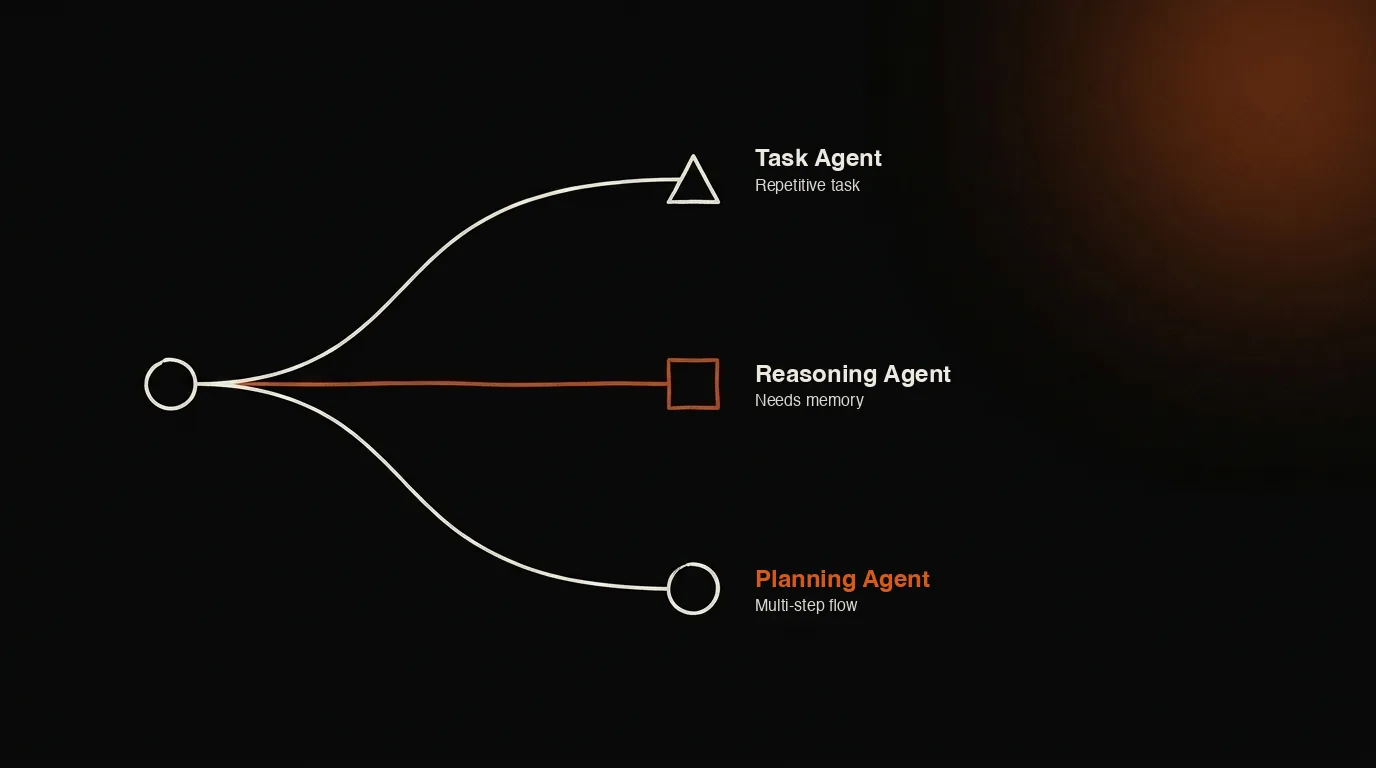
This pretty simple framework helps teams figure out if they need something basic like a simple reflex agent with pre-defined rules, or something that can handle more complex flows, messy environments, and long-term decision-making.
Step 1: Start With the Business Outcome
Before choosing an AI agent, it’s important to define the single business outcome you want to improve. Once that goal is clear, the right starting point usually becomes obvious, and in many cases it’s a simpler agent that can deliver value quickly without unnecessary complexity.
If your primary objective is to:
- Automate repetitive or rule-based tasks, a task agent or simple reflex agent is often enough.
- Surface internal knowledge instantly, such as documents, tickets, or CRM data, a retrieval agent fits best.
- Make decisions that depend on multiple variables, like cost, risk, or timing, a reasoning agent is more appropriate.
- Run a process with several dependent steps, a planning agent can coordinate the workflow end to end.
- Coordinate multiple agents or systems, a multi-agent setup becomes necessary.
- Adapt and improve without constant human input, an autonomous agent is the right direction.
- Interact with users through natural language, a chat or conversational agent provides the interface.
For most teams, this simple framing is enough to narrow down the right category in minutes and avoid overengineering from the start.
Step 2: What Each Agent Is Designed to Deliver
Once the goal is clear, the next step is understanding what each type of AI agent actually brings to the table. Instead of focusing on technical labels, it helps to look at the practical outcome each agent is built to deliver.
Task Agents
Best for execution and operational efficiency
Task agents handle repetitive, well-defined activities inside existing systems. They follow clear rules, respond to triggers, and complete actions with minimal human involvement. Businesses typically use them to automate data cleanup, routine updates, internal processes, or simple workflows that would otherwise consume team time.
Retrieval Agents
Best for fast access to internal knowledge
Retrieval agents surface relevant information from internal sources such as CRMs, emails, documentation, or support systems. Rather than searching manually, users can query the system directly and get accurate answers. These agents are commonly used in customer support, internal knowledge bases, and AI-powered assistants.
Reasoning Agents
Best for decision-making across multiple variables
Reasoning agents go beyond immediate responses. They evaluate historical data, recognize patterns, and compare possible future outcomes before acting. This makes them well suited for use cases like logistics optimization, financial analysis, pricing decisions, or any scenario where trade-offs matter.
Planning Agents
Best for coordinating multi-step workflows
Planning agents are designed for processes that involve sequencing, dependencies, and changing conditions. They map out actions in advance, adjust plans when constraints shift, and ensure tasks happen in the right order. Common examples include supply chain planning, maintenance scheduling, and infrastructure management.
Multi-Agent Systems
Best for complex environments with distributed responsibility
Some problems are too large or dynamic for a single agent. Multi-agent systems allow several agents to operate in the same environment, coordinating, negotiating, or dividing work between them. These setups are common in robotics, autonomous vehicles, simulations, and large-scale operational systems.
Autonomous Agents
Best for environments that change constantly
Autonomous agents operate with minimal human oversight. They maintain internal models, learn from feedback, and adapt their behavior over time using reinforcement learning. Businesses apply them in areas like energy optimization, predictive maintenance, and other domains where conditions are unpredictable.
Chat and Conversational Agents
Best for human-facing interaction
Chat agents act as the interface between users and AI systems. Using natural language understanding, they interpret requests, route tasks to other agents, and return results in a conversational format. They are widely used in virtual assistants, customer support, and internal service tools.
Step 3: Combine Agent Types When the Workflow Demands It
In real business environments, a single AI agent is rarely enough. Most effective implementations combine multiple agent types, each responsible for a specific part of the workflow.
A typical setup might look like this:
- A chat or conversational agent captures and interprets the user’s request.
- A retrieval agent gathers the relevant data from internal systems and knowledge sources.
- A planning or reasoning agent coordinates the required steps and executes the process end to end.
This layered approach allows businesses to handle more complex use cases without overwhelming users with new tools or interfaces. By separating interaction, information access, and execution, teams get more reliable results while keeping workflows simple and scalable.
Real-World Use Cases
While AI agents can be described in abstract models and architectures, their real value shows up in everyday business operations. Across teams and industries, companies are using different combinations of AI agents to remove manual work, improve decision-making, and keep processes moving without constant human involvement. Below are a few practical examples of how AI agents are applied in core business functions.
Marketing
AI Agents automate repetitive tasks like research, SEO updates, and data collection. Reasoning AI agents help interpret customer behavior, while chat agents provide personalized customer experiences.
Sales
Lead scoring becomes more accurate with data-driven decisions. AI Agents clean CRM fields, prepare proposals from past documents, and help route support tickets.
Operations
Planning and reasoning AI agents use real-time data to improve logistics routing, optimize fuel efficiency, detect anomalies, and choose the most efficient route under changing environments.
HR
AI Agents filter resumes, manage onboarding with predefined steps, maintain a knowledge base, and answer employee questions with natural language inputs.
What AI Agent Projects Cost
To get a realistic picture of what AI agent projects cost in 2025, it’s better to rely on market data rather than assumptions. A detailed breakdown is available in our guide How Much Does It Cost to Build an AI Agent?, but here’s a high-level overview relevant to the agent types discussed in this article.
- $3k–$15k: Simple agents handling straightforward, well-defined tasks such as automation, basic integrations, or rule-based workflows.
- $20k–$60k: Reasoning or planning agents connected to internal systems and external tools, capable of handling multi-step processes and decision-making.
- $60k–$200k+ per month: Advanced implementations involving multiple agents, complex coordination, custom infrastructure, or highly autonomous systems that orchestrate large workflows across teams and platforms.
Ongoing maintenance should also be factored in. Maintaining AI agents is similar to managing a small digital team: models need monitoring, integrations require updates, and performance improves over time through continuous tuning and feedback.
How to Get Started Without Overengineering
Most failed AI agent initiatives don’t fail because of the technology. They fail because teams try to solve too much at once. The fastest way to get value is to treat the first implementation as a controlled experiment, not a transformation project.
- Start by identifying one workflow bottleneck that clearly wastes time or creates delays. This should be a problem that people complain about regularly, not a hypothetical “nice to have.” Clear pain creates clear success criteria.
- Next, map that problem to the simplest agent capable of improving it. Many teams jump straight to autonomous or multi-agent systems when a task, retrieval, or reasoning agent would deliver results faster and with less risk. The goal at this stage is not sophistication, but reliability.
- Then, integrate the agent into the tools your team already uses. AI agents work best when they reduce context switching rather than introduce new dashboards. If adoption requires behavior change, the experiment is already at risk.
- Once connected, run a small, time-boxed pilot with real users and real data. Observe where the agent helps, where it fails, and where human oversight is still required. Feedback at this stage is more valuable than performance metrics alone.
Only after the agent consistently delivers value should you consider scaling, expanding its scope, or combining it with other agent types. This incremental approach keeps costs under control, builds internal trust, and turns AI agents into a practical asset instead of an ongoing experiment.
Conclusion
AI agents offer a practical path to automating work that once required constant human attention. When applied thoughtfully, they help teams move faster, handle complexity more effectively, and make better decisions across everyday business processes.
The key is not to adopt AI everywhere at once, but to start with a clear objective, choose the agent type that fits the problem, and expand only when real value is proven. Over time, individual agents can evolve into coordinated systems that adapt to change, support human teams, and turn fragmented workflows into something far more coherent and scalable.
If you’re exploring how AI agents could fit into your business, Product Crafters helps teams move from ideas to working systems. We design and build AI agents around real workflows, existing tools, and measurable outcomes — so adoption is practical, not experimental.