Custom Agentic AI Development
Agentic AI Development Services
Agentic AI systems that plan, reason, call tools, and act — not just answer questions. Multi-agent orchestration, vertical agents, copilots, autonomous workflow agents. We pick the simplest architecture that solves the problem, ship to production in 4–12 weeks, and stay on through the messy operational phase that most agentic AI pilots skip.
Oleg Kalyta
Founder & AI Lead
Your 90-Day Roadmap
Free Trial
Test our team, no commitmentProof of Concept
Working prototype deliveredProduction Ready
Full AI solution deployedOur Agentic AI Development Services
Multi-Agent System Development
AI Agent Development
Agentic AI for Customer Support
AI Chatbot & Conversational Agents
RAG-Powered Agents
Agentic AI Integration
LLM-Powered Agents
Agentic AI Consulting & PoC
Agentic AI Development Case Studies
Two production agentic AI systems with measurable outcomes — not pilots, not demos.

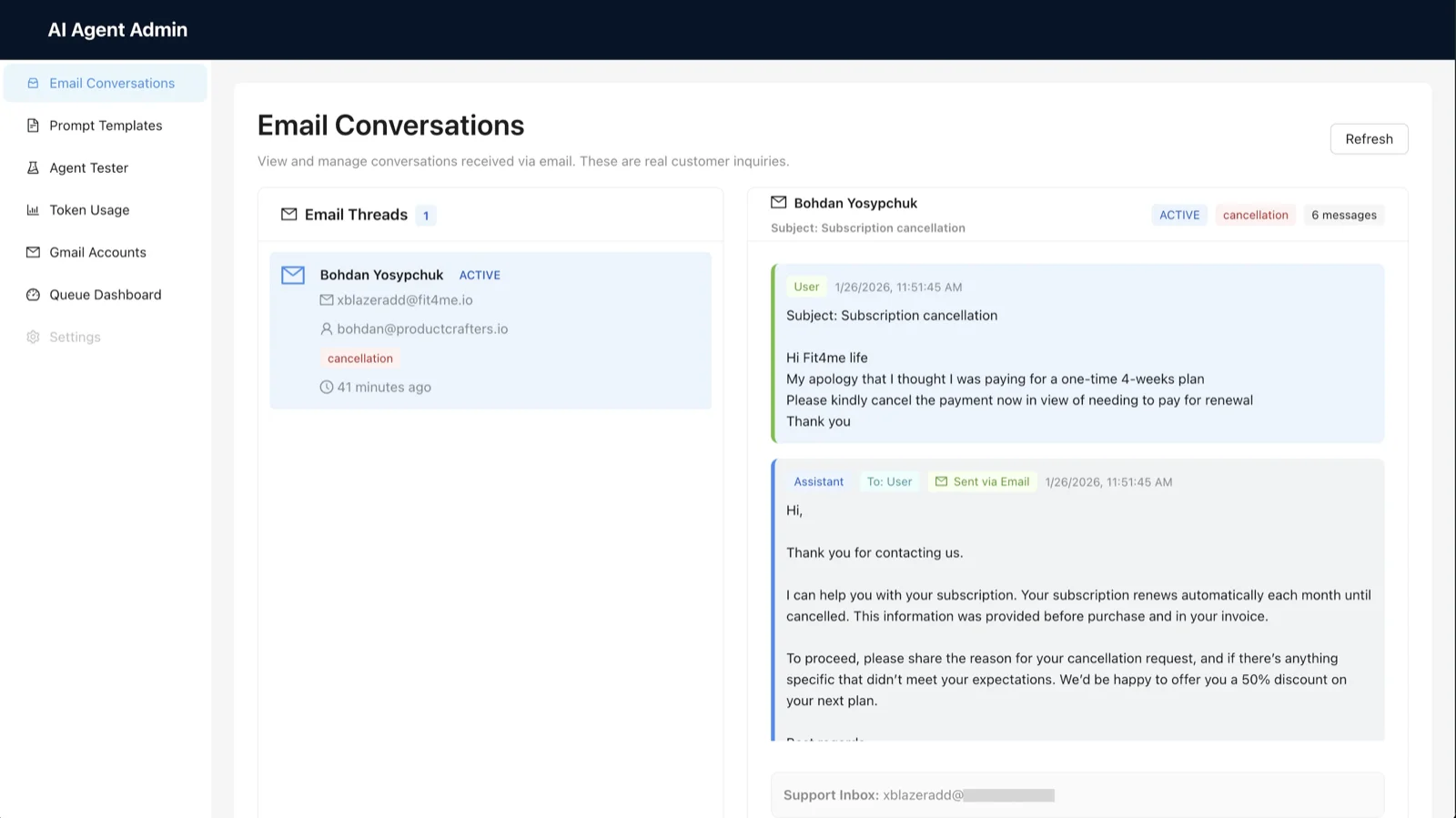
AI Support Agent
Case Study
Agentic Customer Service for a Fitness App
An agentic AI system that handles refund and cancellation requests autonomously for a fitness app with thousands of daily users. The agent verifies the account, checks the policy, files the refund or cancellation, and escalates only the edge cases. Response time dropped from 4 hours to under a minute, preventing chargebacks by addressing concerns before they escalate.
Discover case study

Healify
Case Study
Agentic AI for Personalized Health
AI-driven mobile app using intelligent agents to analyze health data, deliver personalized recommendations, and surface proactive insights. The system orchestrates multiple specialized agents — data parser, recommendation generator, follow-up planner — under HIPAA-grade controls. Raised $2M in seed funding within six months of MVP launch.
Discover case study
Agentic AI Solutions We Build
The five agentic AI archetypes that cover most enterprise work. We have shipped production systems in each — and we are happy to tell you when a simpler pattern would do.

Multi-Agent Systems

Vertical Agents

AI Copilots

Autonomous Workflow Agents

RAG-Grounded Agents
What Founders Say
Transparent pricing based on project scope and complexity.
Here's what typical ML initiatives cost based on projects we've delivered.
What most impressed me about ProductCrafters was their dedication to my project and understanding of our goals. They were very honest and transparent throughout the entire process.
They were flexible, and it was easy to work with them on a day-to-day basis. Their brilliant ideas were critical to the project success.

Out of over 40 applicants, we selected ProductCrafters based on their experience, technical expertise, and cost estimate. The team showed deep technical expertise, a strong work ethic, and honesty.

The team has honest billing practices and creates incredible value for the cost. Working with ProductCrafters has saved us hundreds of thousands of dollars compared to domestic firms.

The quality of their code makes them a valuable partner. They thought holistically about solutions and brought up all-encompassing ideas.

Their insightful advice has maximized the application's performance. We're actually learning things from ProductCrafters that we can adapt and use in other applications.
What most impressed me about ProductCrafters was their dedication to my project and understanding of our goals. They were very honest and transparent throughout the entire process.
They were flexible, and it was easy to work with them on a day-to-day basis. Their brilliant ideas were critical to the project success.

Out of over 40 applicants, we selected ProductCrafters based on their experience, technical expertise, and cost estimate. The team showed deep technical expertise, a strong work ethic, and honesty.

The team has honest billing practices and creates incredible value for the cost. Working with ProductCrafters has saved us hundreds of thousands of dollars compared to domestic firms.

The quality of their code makes them a valuable partner. They thought holistically about solutions and brought up all-encompassing ideas.

Their insightful advice has maximized the application's performance. We're actually learning things from ProductCrafters that we can adapt and use in other applications.
Recognition
Trusted by Industry Leaders


Single Agent or Multi-Agent System?
Book a free 30-minute assessment. We will walk through your workflow and tell you which agentic AI development services fit — and which ones do not. Just a senior engineer, no sales pitch.

How We Build Agentic AI: Our Process
The Agentic AI Tech Stack We Work With
LLMs & Foundation Models
OpenAI
Anthropic
Gemini
OpenAI
Anthropic
Gemini
OpenAI
Anthropic
Gemini
OpenAI
Anthropic
Gemini
OpenAI
Anthropic
Gemini
OpenAI
Anthropic
Gemini
Agent Frameworks
LangGraph
LangChain
LangSmith
LangGraph
LangChain
LangSmith
LangGraph
LangChain
LangSmith
LangGraph
LangChain
LangSmith
LangGraph
LangChain
LangSmith
LangGraph
LangChain
LangSmith
Vector Databases
Pinecone
Weaviate
Chroma
Pinecone
Weaviate
Chroma
Pinecone
Weaviate
Chroma
Pinecone
Weaviate
Chroma
Pinecone
Weaviate
Chroma
Pinecone
Weaviate
Chroma
Speech & Multimodal
ElevenLabs
Whisper
Replicate
ElevenLabs
Whisper
Replicate
ElevenLabs
Whisper
Replicate
ElevenLabs
Whisper
Replicate
ElevenLabs
Whisper
Replicate
ElevenLabs
Whisper
Replicate
Why Work With ProductCrafters on Agentic AI

Production Agentic AI, Not Pilots That Stall

Fixed-Price Agentic AI Development from $15K

Framework Choice With Reasons, Not Logos

From PoC to Production in 4–12 Weeks

Human-in-the-Loop and Audit Logs by Default
FaQ
What are agentic AI development services?
Agentic AI development services cover the end-to-end work of building production AI systems that plan, reason, and act autonomously across multi-step workflows — not just answer questions. The scope includes strategy, data readiness, agent topology design (single agent vs multi-agent), framework selection (LangGraph, CrewAI, AutoGen, or custom), prompt engineering, tool integration with enterprise systems (Salesforce, SAP, Zendesk, Slack), evaluation suites, deployment, monitoring, and ongoing operation. At ProductCrafters, we ship production agentic AI in 4–12 weeks for $15K–$75K fixed-price.

What is the difference between agentic AI and traditional AI or AI agents?
Traditional AI — classifiers, predictors, generative models — produces an output. Agentic AI plans actions, calls tools, evaluates outcomes, and adjusts on the fly. A traditional AI model labels an email as a refund request; an agentic AI system reads the email, verifies the account, checks the policy, files the refund, and posts a confirmation. The "AI agent" term is sometimes used for both single-purpose tool-using agents and full agentic AI systems — the distinction we draw is that agentic AI implies planning and multi-step reasoning, where an AI agent in the narrow sense may be a one-shot tool caller. See our AI Agent Development page for the single-agent case.
How much do agentic AI development services cost?
A discovery workshop runs $3K–$5K. A fixed-price agentic AI development project ranges from $15K–$75K depending on agent count, tool integrations, evaluation suite depth, and compliance scope. Multi-agent enterprise systems with deep ERP and CRM integration can exceed $100K. Managed retainers for ongoing optimization start at $5K/month. We quote on scope, not hours — the number you sign for is the number you pay. Cheaper quotes from other agencies usually cover a single agent with one or two tool calls; "production agentic AI" with audit logs, rollback, and evaluation rarely lands under $15K.
How long does an agentic AI project take?
A focused agentic AI proof of concept takes 2–3 weeks. A production-ready agentic AI system typically runs 4–12 weeks from kickoff to deployment, depending on data readiness, tool-integration scope, and compliance requirements. Enterprise multi-agent systems with deep ERP integration or regulated-industry compliance can push to 16–20 weeks. We split delivery into discovery, PoC, build, integration, and operate — each with a fixed-duration milestone.
What industries benefit most from agentic AI development services?
Agentic AI lands best where there is high-volume process work with multi-step decision flows and clear ROI: customer support (refund and cancellation triage), fintech (KYC, claims processing, fraud investigation), healthcare (prior authorization, clinical decision support, patient onboarding), insurance (claims validation and underwriting), retail and ecommerce (supplier onboarding, returns processing), IT operations (incident triage, ticket resolution), and back-office finance (invoice processing, reconciliation). The common thread: three-or-more reasoning steps and a deterministic outcome the agent can verify before closing the loop.
How do you ensure agentic AI is safe — human-in-the-loop, audit logs, rollback?
Four things, all on by default. First, confidence-gated escalation: the agent only acts autonomously when its confidence clears a threshold you set; everything else routes to a human. Second, audit logs on every tool call — what the agent decided, what data it read, what action it took, what the outcome was. Third, rollback paths: every action the agent takes has a documented reversal procedure, and high-stakes actions require human approval before commit. Fourth, evaluation suites that run continuously in production, not just in development — so a regression in agent behavior is caught in hours, not weeks.
Can we start with an agentic AI proof of concept before full development?
Yes — and we recommend it. A 2–3 week PoC against real data is far better evidence than a 6-month feasibility report. We build the simplest version that can succeed, benchmark it against the production target on accuracy, latency, and cost per task, and only scope full agentic development after the PoC clears agreed thresholds. About 1 in 5 PoCs ends with "do not build this" — usually because the data is not ready or a simpler RPA flow would solve the same problem cheaper. That is a good outcome.
What is multi-agent orchestration and when do we need it?
Multi-agent orchestration is the pattern where specialized agents coordinate a workflow — one routes the request, one researches the knowledge base, one calls tools to act, one verifies the outcome. You need it when a single agent with many tools becomes brittle or unauditable, or when the workflow naturally splits across roles (research vs decision vs execution). You do not need it when one well-prompted agent with two or three tool calls can do the job — and we will say so. About 60% of our agentic AI engagements ship as single-agent systems, not multi-agent.
How do you handle data privacy, security, and compliance?
Encrypted transfer, strict access controls, audit logs, and alignment with GDPR, HIPAA, SOC 2, the EU AI Act, and NIST AI RMF. Industry-specific requirements are designed in from day one — HIPAA for healthcare, FINRA for financial recordkeeping, SOX for financial reporting. When data residency is a concern, the agentic AI system runs in your own VPC; we do not require data to leave your infrastructure. Tool calls touching regulated systems are gated behind role-based access and logged for audit.
Will agentic AI replace our team?
Mostly no — and where it does, the team should welcome it. The work agentic AI handles best is the repetitive multi-step process work that drains senior people: triaging refund requests, reconciling invoices, processing claims, routing IT tickets. Freeing the team from that work usually means they do the higher-judgment work they were hired for and never had time for. The framing we use with clients: build the agentic system to handle the bottom-third of tasks by complexity, escalate the rest, and measure the team gain in throughput rather than headcount.
Ready to Ship Production Agentic AI?

Your Free Trial Sprint
Meet your team
Slack channel, assigned developer, daily standups. First code committed to your GitHub.Working prototype delivered
Technical spike or prototype complete. Architecture + budget roadmap for the full build.You keep everything. Zero cost. Zero commitment.

Oleg Kalyta
Founder & AI Lead- 1.You submit—We review within 24 hours
- 2.15-minute scoping call—We align on trial goals
- 3.Developer assigned—Within 48 hours
- 4.Working code in your repo—By end of Week 1