



During Cyber Week 2025, 20% of all global ecommerce orders were influenced by AI agents or shopping assistants, according to Salesforce. This isn’t a future projection—it’s happening now. As Morgan Stanley projects, agentic commerce could capture $190 billion to $385 billion in U.S. e-commerce spending by 2030, representing 10-20% of market share.
Yet most merchants are still figuring out where to begin. Only 7% of organizations have moved beyond experimentation to fully scaled AI deployments. The gap between early adopters and everyone else is widening fast—businesses that implement AI agents today are seeing conversion rates 4x higher than those relying on traditional shopping experiences.
This guide breaks down exactly what an ai agent for ecommerce can do for your business, the 10 types of agents driving real results, and how to choose the right solution without wasting months on the wrong approach. Whether you’re looking to improve the customer experience, streamline operations, or discover new ways to grow revenue, understanding AI agents is essential for success in today’s retail landscape.


Table of Contents
What is an AI Agent for Ecommerce?
An AI agent for ecommerce is autonomous software that handles e-commerce tasks without constant human intervention. Unlike basic recommendation engines or simple chatbots that follow rigid scripts, AI agents understand context, make decisions, learn from customer behavior, and take action across multiple systems.
Think of the difference this way: a basic chatbot responds to keywords with pre-written answers. An AI agent understands that when a customer asks “where’s my order?” they need tracking information, checks the order management system, identifies potential shipping delays, and proactively offers solutions—all in real time.
Key Characteristics That Make AI Agents “Agentic”
What separates true AI agents from traditional automation tools comes down to several capabilities:
- Autonomy: Agents operate independently, making decisions without requiring human attention for every transaction. They handle routine inquiries, process returns, and manage inventory levels automatically.
- Context awareness: They maintain memory of previous interactions, understanding purchase history, customer preferences, and past issues to deliver personalized experiences.
- Goal-oriented behavior: Rather than following simple if-then rules, agents work toward objectives—completing a sale, resolving a complaint, or optimizing inventory.
- Learning capability: AI agents improve over time, analyzing what works and adjusting their approach based on customer satisfaction and business outcomes.
- Multi-system integration: They connect with your CRM, inventory platform, payment systems, and marketing tools to act on structured data across your entire stack.
AI Agents vs. AI Tools vs. Automation Tools
The commerce technology landscape includes many solutions that get lumped together incorrectly. Here’s how to identify what you’re actually evaluating:
Automation tools execute predefined workflows. They’re powerful for routine tasks but can’t handle exceptions or make judgment calls. When a customer asks something unexpected, the workflow breaks.
AI tools use artificial intelligence for specific functions—like generating product descriptions or analyzing customer behavior. They’re powerful within their domain but require human intervention to connect insights to action.
AI agents combine intelligence with autonomy. They understand intent, reason through problems, and execute actions across systems. When a customer asks to “change my subscription and process returns for my last order,” an agent handles both tasks without human escalation.
Table: Understanding the Difference
| Capability | Automation Tools | AI Tools | AI Agents |
|---|---|---|---|
| Handles exceptions | No | Limited | Yes |
| Context awareness | No | Partial | Full |
| Takes autonomous action | Predefined only | No | Yes |
| Learns from outcomes | No | Domain-specific | Yes |
| Multi-system operations | Limited | Limited | Native |
The Best AI Agents for Ecommerce: 10 Types Driving Results
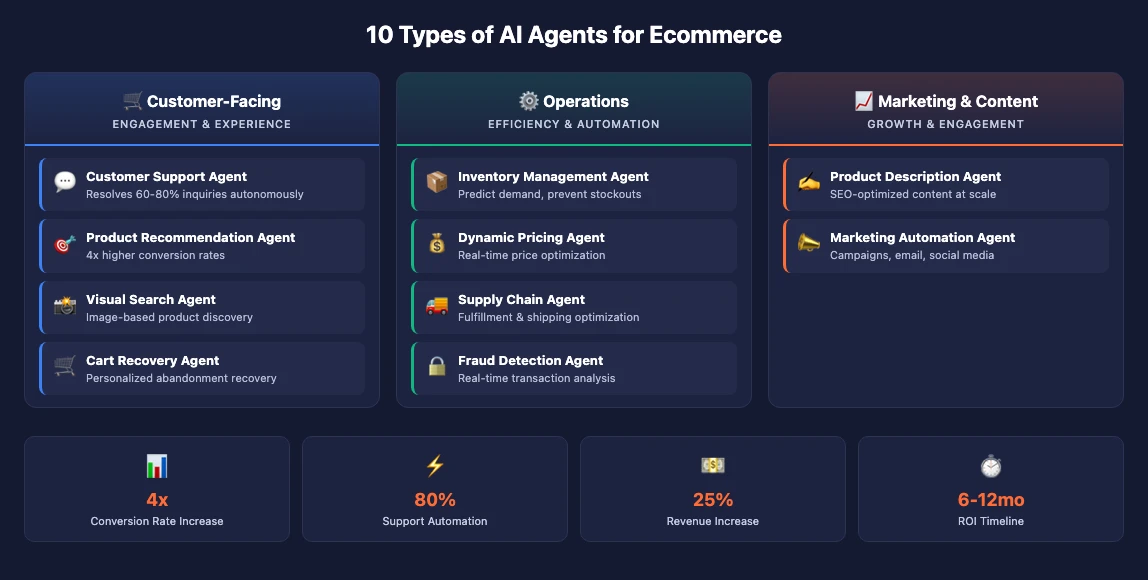
Not all AI agents serve the same purpose. Understanding the categories helps you prioritize based on your biggest operational challenges and revenue opportunities. For a deeper exploration of agent architectures, see our guide on Types of AI Agents.
1. Customer Support AI Agents
Customer support agents handle incoming inquiries across chat, email, and social media. Leading ecommerce retailers achieve an 80% automation rate, with AI agents resolving 53% of all incoming queries without human intervention, according to DemandSage research.
The business impact is substantial. First response time drops from over 6 hours to less than 4 minutes. Resolution time can decrease from 32 hours to 32 minutes. Most ecommerce stores save $24,000-54,000 per year by automating 50-75% of their support volume.
When a customer asks about an order, requests a refund, or needs help with a return, these agents access order data, apply business rules, and complete the transaction. Complex problems automatically escalate to human agents with full context preserved.
2. Personalized Product Recommendation Agents
Recommendation agents analyze customer behavior, purchase history, and browsing patterns to surface relevant products. But unlike basic recommendation engines that show “customers also bought,” AI agents understand shopping intent and adjust suggestions in real time.
The conversion impact is dramatic: users who engage with AI shopping assistants convert at 4x the rate of those browsing unassisted. During the 2025 holiday season, shoppers arriving from generative AI sources converted at rates 31% higher than traditional traffic. This is why AI-powered e-commerce is becoming the standard rather than the exception.
These agents don’t just recommend—they explain why a product fits. When a customer asks “which laptop works for video editing under $1,500?”, the agent evaluates specifications, reviews, and inventory levels to provide a curated recommendation with reasoning.
3. Inventory Management AI Agents
Inventory agents monitor stock levels, predict demand, and automate reordering. They analyze sales velocity, seasonal patterns, and external factors to prevent stockouts while minimizing excess inventory.
These agents integrate with your supply chain, automatically adjusting safety stock based on carrier performance and supplier lead times. When managing inventory across multiple warehouses, they optimize placement to reduce shipping costs and delivery times.
For merchants with high volume and complex catalogs, inventory agents reduce carrying costs while improving product discovery—customers can only buy what’s in stock.

4. Dynamic Pricing AI Agents
Pricing agents analyze competitor prices, demand signals, and inventory levels to adjust prices in real time. They respond to market conditions faster than manual processes while protecting margins.
These agents balance multiple objectives: maximize revenue while maintaining customer satisfaction and brand positioning. They can implement different strategies by segment—offering personalized pricing to loyalty members while staying competitive on comparison-shopped products.
5. Product Description Generation Agents
Content agents create and optimize product descriptions at scale. For merchants with thousands of items, manually writing compelling descriptions is impossible. AI agents generate unique, SEO-optimized content while maintaining brand voice across your entire catalog.
Beyond initial creation, these agents A/B test descriptions, analyze conversion data, and refine copy based on what drives sales. They identify which product details matter most to shoppers and emphasize those features.
6. Visual Search AI Agents
Visual search agents let customers discover products using images rather than text queries. When a shopper uploads a photo of furniture they like, the agent identifies style, color, and form to surface matching items from your catalog.
This capability transforms product discovery—customers often know what they want visually but struggle to describe it in searches. Visual search removes that friction, connecting intent directly to inventory.
7. Cart Abandonment Recovery Agents
Recovery agents identify when shoppers abandon carts and deploy personalized interventions. Rather than generic “you left something behind” emails, they analyze abandonment reasons and craft relevant responses.
Did the customer leave because of shipping costs? The agent might offer free shipping on orders over a threshold. Was it price sensitivity? A limited-time discount could convert. These agents test different approaches and learn which tactics work for different customer segments.
8. Fraud Detection AI Agents
Fraud agents analyze transactions in real time, identifying suspicious patterns while minimizing false positives that block legitimate customers. They evaluate hundreds of signals—device fingerprints, behavioral patterns, transaction velocity—to detect and resolve fraud ahead of chargebacks.
For high-risk categories or high-volume merchants, fraud agents provide essential protection without adding checkout friction.
9. Supply Chain Optimization Agents
Supply chain agents coordinate fulfillment across warehouses, carriers, and delivery windows. They optimize shipping decisions in real time—selecting carriers based on cost, speed, and reliability for each order.
These agents handle complex problems like split shipments, backorders, and carrier exceptions. When a shipping delay occurs, they proactively notify customers and offer alternatives rather than waiting for complaints.
10. Content Creation and Marketing Agents
Marketing agents automate campaign creation, social media content, and email sequences. They generate ad copy, test variations, and allocate budget based on performance data.
For ecommerce brands, these agents create product-focused content that drives sales while maintaining consistent messaging across channels. They respond to trends, seasonal events, and inventory changes with relevant promotions.

Increase Conversion Rates and Drive Sales with AI Agents
The business case for AI agents centers on measurable outcomes: higher conversion rates, lower support costs, and increased revenue per customer. Here’s what the data shows.
Drive Sales with Generative Product Recommendations
AI-powered product recommendations fundamentally change how consumers discover and purchase products. According to 2026 conversion data, brands implementing AI recommendation agents report a 4x increase in conversion rates for assisted shopping.
Revenue impact is equally significant. Companies implementing AI sales agents report 7-25% revenue increases. The combination of better product discovery, personalized experiences, and reduced friction creates compounding value.
Automate Post-Purchase Complex Workflows
Post-purchase operations consume significant resources: order tracking, returns, exchanges, and refunds. AI agents automate these workflows while maintaining customer satisfaction.
Leading platforms like Gorgias report their AI agents resolve 60% of support inquiries autonomously while increasing conversions 2.5x through tailored recommendations. We’ve seen similar results with our AI support agent implementation for a fitness app—handling refund and cancellation requests with 1-minute response times at $0.02 per conversation. When agents handle routine requests, human teams focus on high-value interactions that build loyalty.
Cost reduction follows automation. Conversational AI is projected to save $80 billion in contact-center labor costs by 2026. For individual merchants, the savings depend on volume—but most see 20-30% reduction in support operating costs while handling 60-80% of inquiries autonomously.
Enhance Human Collaboration and Agent Assist
The most effective implementations combine AI efficiency with human oversight. AI agents handle routine inquiries, gather context, and prepare responses. Human agents step in for complex problems, relationship building, and edge cases.
This collaborative model delivers better outcomes than either pure automation or fully manual support. Customers get fast responses for simple requests and expert attention when needed. Support teams work on interesting problems rather than repetitive tasks.
AI Agent ROI Summary
| Metric | Impact | Source |
|---|---|---|
| Conversion rate increase | 4x for assisted shopping | Envive AI, 2026 |
| Revenue increase | 7-25% | Industry average |
| Support cost reduction | 20-30% | Multiple sources |
| Inquiry automation rate | 60-80% | Gorgias, DemandSage |
| First response time | 6+ hours → 4 minutes | Freshworks, 2025 |
| Annual savings (typical) | $24,000-54,000 | Industry analysis |
How to Choose the Right AI Agent for Your Ecommerce Business
Selecting the right AI agent solution requires matching capabilities to your specific business needs. Here’s a framework for evaluation.
Unify Your Brand Voice Across All Channels
Your AI agent represents your brand in every customer interaction. Before evaluating features, consider how well a platform supports your brand voice.
Leading solutions like Siena AI train on your existing content—support transcripts, marketing copy, and product information—to match your communication style. Test this capability by running sample conversations and evaluating whether responses feel authentic to your brand.
Avoid platforms that force generic responses or require extensive rule-writing to achieve natural conversation. The goal is personalized experiences that feel human, not robotic scripts that frustrate customers.
Integrate with Your Existing Stack
AI agents create value by connecting systems. Evaluate integration capabilities across your critical platforms:
- Ecommerce platform: Shopify, WooCommerce, BigCommerce, Magento, Salesforce Commerce Cloud
- Customer service tools: Zendesk, Freshdesk, Intercom, Help Scout
- Order management: Your OMS, ERP, and fulfillment systems
- Marketing automation: Klaviyo, Mailchimp, Omnisend
- Analytics: Google Analytics, data warehouses, BI tools
Native integrations work better than custom APIs for most merchants. Check which integrations are pre-built versus requiring development work—and factor implementation costs into your evaluation.
Detect and Resolve Issues Ahead
The best AI agents don’t just respond—they anticipate. Look for capabilities that detect and resolve problems before they create customer complaints:
- Proactive shipping delay notifications
- Inventory alerts before stockouts affect orders
- Payment failure recovery sequences
- Subscription renewal reminders
Proactive service builds loyalty while reducing inbound support volume.
Common AI Agent Challenges and How to Mitigate Them
Implementation challenges are predictable. Plan for these common issues:
Training data quality: AI agents learn from your historical data. If your support history contains inconsistent responses or outdated information, the agent inherits those problems. Clean your data before training.
Escalation design: Define clear triggers for human handoff. Complex problems, frustrated customers, and high-value accounts should route to humans. Test your escalation flows before launch.
Monitoring and improvement: AI agents require ongoing attention. Establish metrics, review conversations regularly, and continuously refine responses. Treat it as a team member that needs coaching.
Customer expectations: Not all customers want AI assistance. Provide clear options to reach human support when needed. Transparency about AI involvement builds trust.
How Much Do AI Agents for E-Commerce Cost?
AI agent costs vary significantly based on complexity, customization, and scale. Here’s what to expect across different solution types.
Platform-Based Solutions
SaaS platforms like Gorgias, Tidio, and Intercom offer AI agent capabilities with subscription pricing. Expect $100-1,000+ monthly depending on conversation volume and features. These platforms work well for merchants who want quick deployment without custom development.
Pros: Fast implementation, predictable costs, vendor-managed updates. Cons: Limited customization, potential vendor lock-in, feature constraints.
Custom AI Agent Development
For businesses requiring specialized capabilities or deep integration, custom AI agent development provides maximum flexibility. Development costs range from $20,000-$180,000+ based on complexity:
AI Agent Development Cost Breakdown
| Agent Type | Description | Example Use Case | Cost Range |
|---|---|---|---|
| Reactive/Simple Reflex | Rule-based logic, no memory | Basic FAQ chatbots | $20,000-$35,000 |
| Contextual/Model-Based | Short-term memory, multi-step flows | Onboarding assistants, order support | $40,000-$70,000 |
| Goal-Oriented | Planning, goal pursuit, tool usage | Sales agents, complex support | $70,000-$120,000 |
| Autonomous/Multi-Agent | Full autonomy, learning, orchestration | End-to-end operations | $100,000-$180,000+ |
Custom development makes sense when off-the-shelf solutions can’t handle your requirements—proprietary data, complex business rules, or integration with legacy systems. For a detailed breakdown, see our AI Agent Development Cost guide covering pricing factors from $5K to $180K+.
ROI Timeline
Most businesses achieve positive ROI within 6-12 months. The calculation depends on your baseline costs and improvement targets:
- Support cost savings: 50-75% automation × current support costs
- Revenue increase: Conversion rate improvements × traffic × average order value
- Efficiency gains: Time saved on manual tasks × labor costs
For a concrete example: a merchant spending $100,000 annually on support that achieves 60% automation saves $60,000/year—covering a $40,000 agent investment in under 8 months.
The Future of Agentic Commerce: Start Now or Fall Behind
The agentic AI market in retail and ecommerce is projected to reach $60.43 billion in 2026, growing at 29% annually through 2031. Early adopters are establishing advantages that will be difficult for laggards to overcome.
Consider the trajectory: 89% of retailers are already using or assessing AI projects. By 2028, one-third of online retailers will use advanced AI agents—up from less than 1% today. The transformation is accelerating.

For merchants still evaluating, the question isn’t whether to implement AI agents but how quickly you can start. The learning curve favors early movers—organizations that experiment now build institutional knowledge while competitors are still planning.
Practical Next Steps
Start with high-impact, low-risk applications:
- Customer support automation: Deploy an AI agent for tier-1 support inquiries. Measure resolution rates and customer satisfaction.
- Product recommendations: Implement AI-powered recommendations on product pages and in search results. Track conversion lift.
- Cart abandonment: Launch personalized recovery sequences. Test different approaches and measure recovery rates.
Each success builds confidence and capability for more ambitious implementations. The future of commerce belongs to businesses that combine human creativity with AI efficiency—and the future is arriving faster than most expect.