



AI chatbot development cost ranges from $5,000 to $500,000 or more. That range tells you almost nothing useful. The real number that matters is your three-year total cost of ownership, and most vendor quotes cover only 15-25% of it. A $50,000 platform quote becomes $200,000 once you add data preparation, system integrations, and the ongoing maintenance that vendors conveniently forget to mention. This guide breaks down actual chatbot development costs by category, explains the API token economics that determine whether you should build or buy, and gives you a framework for calculating your real investment before you sign anything.
Table of Contents
The Three Categories: No-Code, Custom, and Hybrid
| Approach | Cost | Timeline | Volume | Best Fit | Deal-Breakers |
| No-Code | $15-$500/mo | 2-4 weeks | <10K/mo | SMBs, FAQ bots, standard support | Custom integrations, compliance, >10K conversations |
| Hybrid | $10K-$50K + subscription | 1-3 months | 10K-50K/mo | Mid-market, 3-5 integrations, some customization | Deep ML requirements, regulated industries |
| Custom | $40K-$500K+ | 6-12 months | >50K/mo | Enterprise, product-embedded, compliance-heavy | Budget <$40K, timeline <3 months, no ML team |
Most chatbot cost guides fail because they treat fundamentally different products as comparable. A $50/month no-code chatbot and a $300,000 custom enterprise build serve different purposes entirely. You need to know which category you’re shopping in before any price makes sense.
No-code platforms handle 70% of business chatbot deployments in 2026, according to industry analysis. These are subscription services where you configure rather than code. Pricing runs $15-$500 per month for small-to-midsize implementations. The trade-off: limited customization, platform dependency, and conversation volume caps that can spike costs unexpectedly. Organizations using no-code platforms report saving $187,000 annually compared to custom chatbot development, but only when their use case fits the platform’s constraints.
Custom development means building a chatbot from scratch with your own team or an agency. AI chatbot development costs range from $40,000 for a basic AI-powered bot to $500,000 or more for enterprise AI with deep integrations. You get full control over the codebase, no per-conversation fees, and the ability to differentiate with unique capabilities. The trade-off: 6-12 month timelines, ongoing maintenance burden, and the need for specialized ML talent.
Hybrid approaches combine a no-code or low-code chatbot platform with custom development for integrations and extensions. Setup costs run $10,000-$50,000 plus platform subscription. This hits the sweet spot for companies that need more than basic features but don’t want to build everything themselves.
The right category depends on three factors: monthly conversation volume, integration complexity, and whether the chatbot is a support tool or a core product feature. A customer support bot handling 3,000 conversations monthly with Zendesk integration is a no-code problem. A financial services bot processing 100,000 interactions monthly with real-time fraud detection is a custom ai chatbot build. Confusing the two is how chatbot projects fail.
AI Chatbot Development Cost Breakdown: Beyond the Quote
Vendor quotes show platform licensing. Your actual spend includes data preparation, integration development, testing, and multi-year maintenance. Research from enterprise AI implementations found that 85% of organizations misestimate AI project costs by more than 10% because they budget for the quote, not the chatbot’s total cost of ownership (Xenoss, 2026).
Here’s what a three-year chatbot development cost actually looks like for a mid-market deployment:
| Cost Component | Year 1 | Year 2 | Year 3 | 3-Year Total |
| Discovery & Design | $13,000 | — | — | $13,000 |
| Platform Licensing | $9,000 | $9,000 | $9,000 | $27,000 |
| Development | $25,000 | $4,000 | $4,000 | $33,000 |
| Integrations | $20,000 | $3,000 | $3,000 | $26,000 |
| Training Data | $15,000 | $5,000 | $5,000 | $25,000 |
| Testing & Launch | $13,000 | — | — | $13,000 |
| Operations | $8,000 | $11,000 | $11,000 | $30,000 |
| Total | $103,000 | $32,000 | $32,000 | $167,000 |


(Source: AgileSoftLabs mid-market analysis, December 2025)
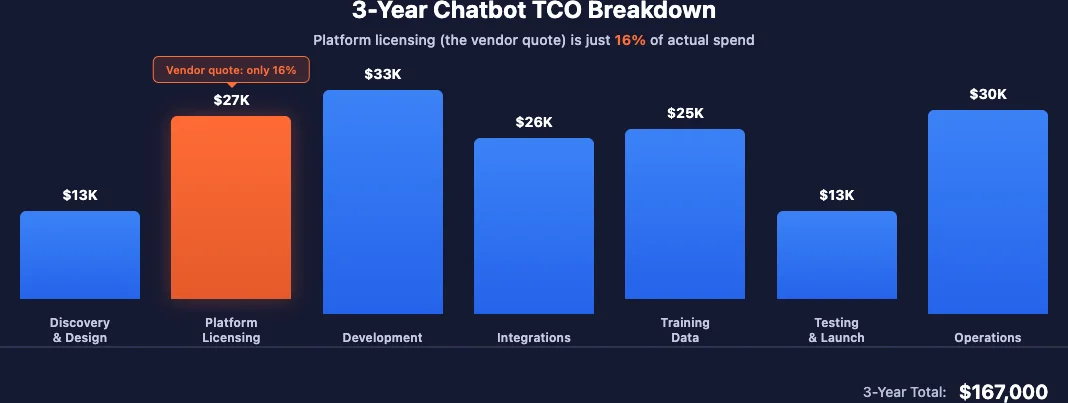
The platform cost (what most vendors quote) represents $27,000 of a $167,000 total cost. That’s 16% of your actual spend.
Data preparation consumes 25-40% of enterprise AI budgets (Xenoss, 2026). This includes collecting conversation logs, labeling intents and entities, cleaning training data, and building evaluation datasets. Most vendors assume you’ll provide this at no cost. You won’t. Budget $15,000-$100,000 depending on chatbot complexity and whether you’re training custom AI models or using off-the-shelf NLP.
Integration development adds 30-50% to your base platform price. Connecting to your CRM, helpdesk, payment processor, and internal databases adds $13,000-$50,000 for typical enterprise setups involving 3-5 systems. Custom API development for proprietary systems can double that. The pattern is consistent. AI integration remains the most underestimated line item in chatbot cost estimates.
Ongoing maintenance runs 15-25% of initial build cost annually. This covers model retraining, security patches, platform updates, and performance optimization. A $100,000 build requires $15,000-$25,000 in year-two maintenance. That number grows as the system accumulates technical debt. Skip the maintenance budget and your chatbot degrades within 6-12 months as user language evolves and your product changes.
Development rates by region significantly impact total cost. The same chatbot built by a North American team versus a Central European team can differ by 40-60% in development cost with comparable quality.
| Region | Hourly Rate | $100K Project |
| North America | $100-$200/hr | $100K-$200K |
| Western Europe | $60-$150/hr | $60K-$150K |
| Central & Eastern Europe | $40-$80/hr | $40K-$80K |
| Asia (India, Philippines) | $30-$60/hr | $30K-$60K |
API Economics: When Per-Token Beats Subscription
Most AI chatbot pricing guides ignore the token economics that determine cost at scale. If you’re building on foundation models from Anthropic or OpenAI, you need to understand when per-token API pricing makes sense versus bundled subscription plans.
Current pricing from Anthropic (April 2026): Claude Opus 4.7 costs $5 per million input tokens and $25 per million output. Sonnet 4.6 runs $3/$15. Haiku 4.5 is $1/$5. Cheaper. The batch API offers a 50% discount for non-real-time processing. Prompt caching reduces repeat query costs by 90%.
Current OpenAI pricing: GPT-4o charges $2.50 per million input tokens and $10 per million output. GPT-4o-mini costs $0.15/$0.60 per million. Much cheaper. Legacy GPT-4 remains at $30/$60 per million for organizations still on older deployments.
What does this mean in practice? A typical customer support conversation runs approximately 2,000 tokens: 500 for the user query plus context, 1,500 for the response. Using Claude Sonnet 4.6, that’s:
- Input: 500 tokens × ($3 ÷ 1,000,000) = $0.0015
- Output: 1,500 tokens × ($15 ÷ 1,000,000) = $0.0225
- Total per conversation: $0.024
At 50,000 conversations per month, your AI chatbot cost runs $1,200. Compare that to no-code platform subscriptions: enterprise tiers typically charge $1,000-$5,000 monthly with conversation limits around 10,000-50,000. The crossover point where API-direct becomes cheaper than subscription varies by chatbot pricing model, but it generally hits around 30,000-50,000 monthly conversations for comparable capability.
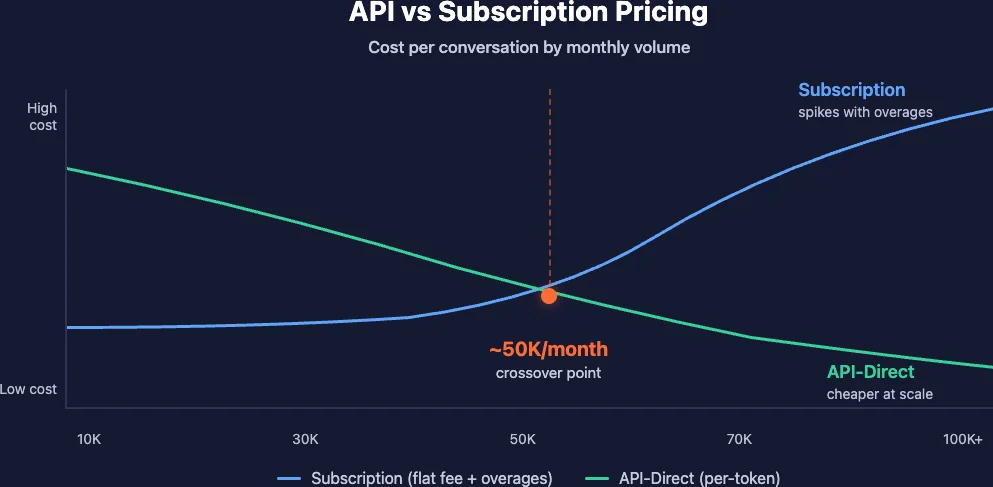
The catch: API-direct requires you to build AI chatbot infrastructure from scratch. That means the conversation interface, session management, error handling, analytics, and user authentication. Add $25,000-$75,000 in development costs. Platform subscriptions bundle that infrastructure.
Batch API usage for non-urgent queries cuts costs in half. A nightly batch job processing 10,000 FAQ responses costs $120 versus $240 for real-time processing with Sonnet. Organizations running mixed workloads (real-time for urgent requests, batch for routine queries) report 40-60% cost reductions versus all-real-time architectures.
The hidden infrastructure cost:
API-direct sounds cheaper until you factor in what platforms bundle for free. Session management (storing conversation state) requires a database. Redis runs $50-$200/month at moderate scale. Rate limiting and retry logic need engineering time. It adds up. Monitoring and alerting add another $100-$300/month for Datadog or similar. Error handling for API failures, timeouts, and content filtering requires custom code. User authentication integration can consume 40-80 engineering hours.
Add it up: the “free” API-direct approach needs $25,000-$75,000 in initial development plus $300-$800/month in infrastructure. At 30,000 conversations monthly, your true cost is $0.03-$0.05 per conversation. Still cheaper than platform subscriptions at scale, but not the $0.024 the raw API math suggests.
When each pricing model wins:
- Per-token API: >50,000 conversations monthly, engineering team available, multi-year horizon
- Usage-based SaaS ($1-$6 per resolution): Variable volume, need turnkey solution, testing product-market fit
- Flat subscription: Predictable volume under 20,000 monthly, budget certainty matters more than optimization
- Hybrid (flat + overage): Growing volumes between 10,000-100,000, scaling rapidly
The worst financial outcome? Choosing per-token API at low volumes. You pay the same infrastructure costs as high-volume users but spread them across fewer conversations. A startup doing 5,000 conversations monthly on API-direct pays $0.10+ per conversation. That’s worse than any subscription tier.
Chatbot ROI: When the Investment Pays Off
Chatbot ROI depends on three measurable factors: cost per conversation before and after deployment, deflection rate (percentage of queries handled without human escalation), and customer satisfaction impact. Get the math right and chatbots deliver 3-5x returns within 18 months. Get it wrong and you’re sunset the project after burning $200,000.
The cost-per-conversation math:
Human support agents cost $4-$8 per conversation. That includes salary, benefits, training, management overhead, and workspace. A well-implemented chatbot? $0.50-$2.00 per conversation including platform fees, API costs, and maintenance. At 10,000 monthly conversations with 50% deflection rate, you save $15,000-$30,000 monthly. Annual savings: $180,000-$360,000.
But here’s where the math breaks down. Most organizations achieve 35-45% deflection rates in the first year, not the 70-80% that vendors promise. And deflection rate requires careful measurement. Routing a frustrated customer to a human agent doesn’t count as deflection, even if the bot technically “handled” the initial query. Vodafone achieved a 70% reduction in cost-per-chat after implementing their AI chatbot (Freshworks, 2025), but they also invested $400,000+ in implementation and spent 18 months optimizing the system.
Timeline to positive ROI:
No-code platforms hit initial value in 30-60 days, full ROI in 3-6 months. Fast. Hybrid implementations take 4-8 months to break even, 12-18 months to full ROI. Custom builds need 8-14 months to break even, 24-36 months to full ROI. Patience required.
A real-world example: $0.02 per conversation in production
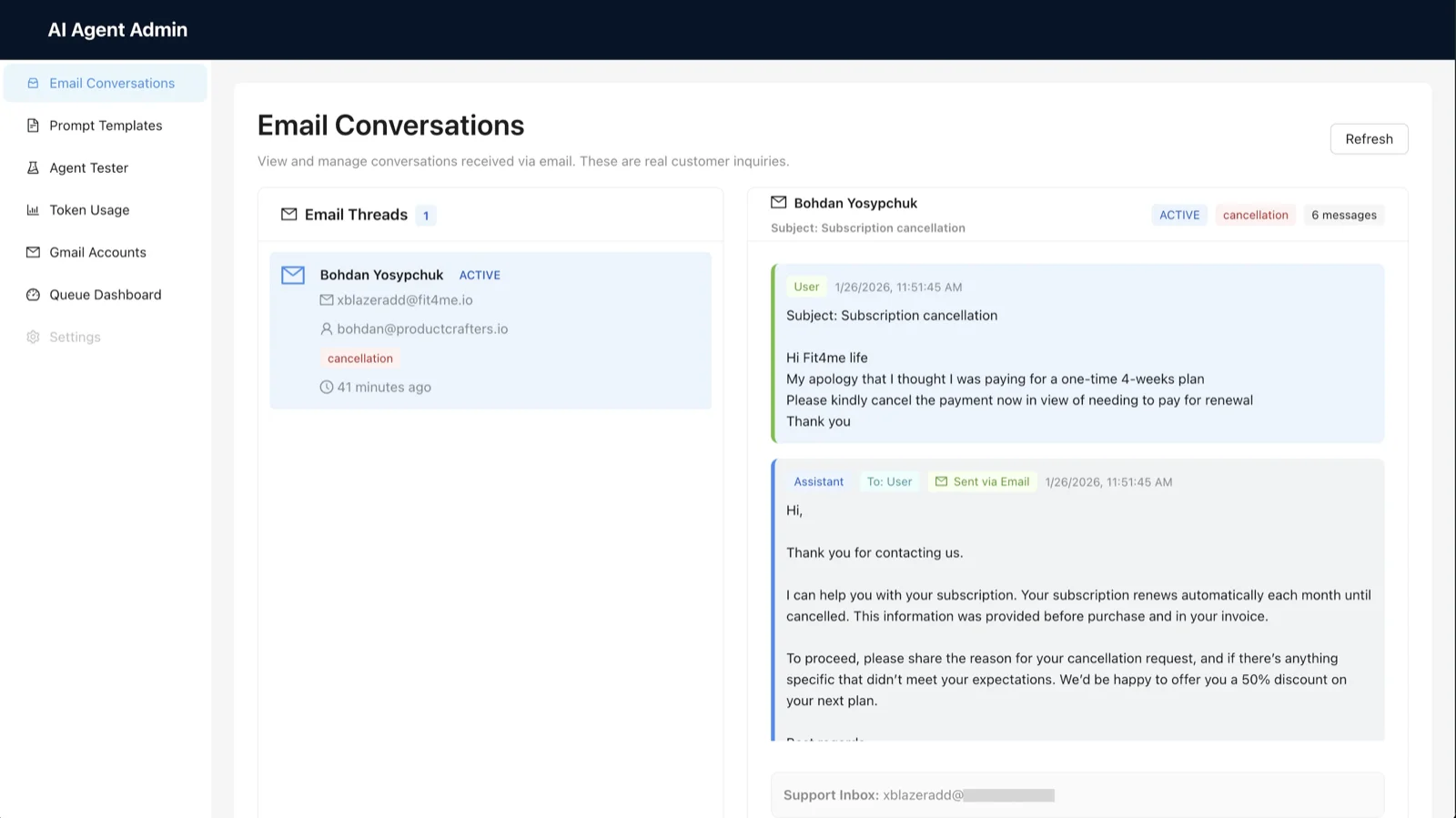
One of our clients — a US fitness app with thousands of daily users — came to us with a chargeback problem, not a support problem. Their team couldn’t respond to US customers fast enough. Refund requests sat in the queue for hours during peak times, and frustrated users went straight to their bank instead of waiting. Each chargeback meant lost revenue, processor fees, and risk to their merchant account. Manual 24/7 staffing would have cost more than the chargebacks themselves.
We built an Chatbot that pulls user activity data from Amplitude to check refund eligibility against policy, drafts a response, and creates a CRM ticket with a proposed decision for the support team to approve. Human-in-the-loop, but the human reviews instead of writing from scratch. PII gets stripped before anything reaches the LLM.
Reply time dropped from four hours to under one minute. Operating cost runs $0.02 per conversation across thousands of daily users — well below the $0.50–$2.00 range cited above, because there’s no platform subscription in the middle. Just the LLM call, the integrations, and infrastructure we already own. Chargebacks fell because the response window closed before customer frustration could escalate.
-
 USA
USA

- LangSmith
- LangGraph
- 1 min Reply time
- $0.02 Conversation
- 60 days Duration

The Gartner projection that conversational AI will save $80 billion in contact center costs by 2026 assumes enterprise-scale deployments with proper implementation. Most organizations aren’t there. The median chatbot project takes 14 months to show positive ROI. And 40% never get there because they’re abandoned before the investment matures.
What kills ROI:
Underinvestment in training data cuts deflection rates by 20-30%. Skipping maintenance for 6 months drops accuracy below acceptable thresholds. Choosing the wrong category (custom when no-code would suffice, or no-code when scale demands custom) either wastes money upfront or forces expensive migrations later. The total AI investment needs to match the problem scope from day one.

Hidden Costs That Kill Chatbot Projects
Gartner reported that 85% of AI projects fail due to poor data quality or insufficient relevant data (Gartner, February 2025). Chatbot development costs vary wildly between quoted and actual because specific hidden costs derail projects.
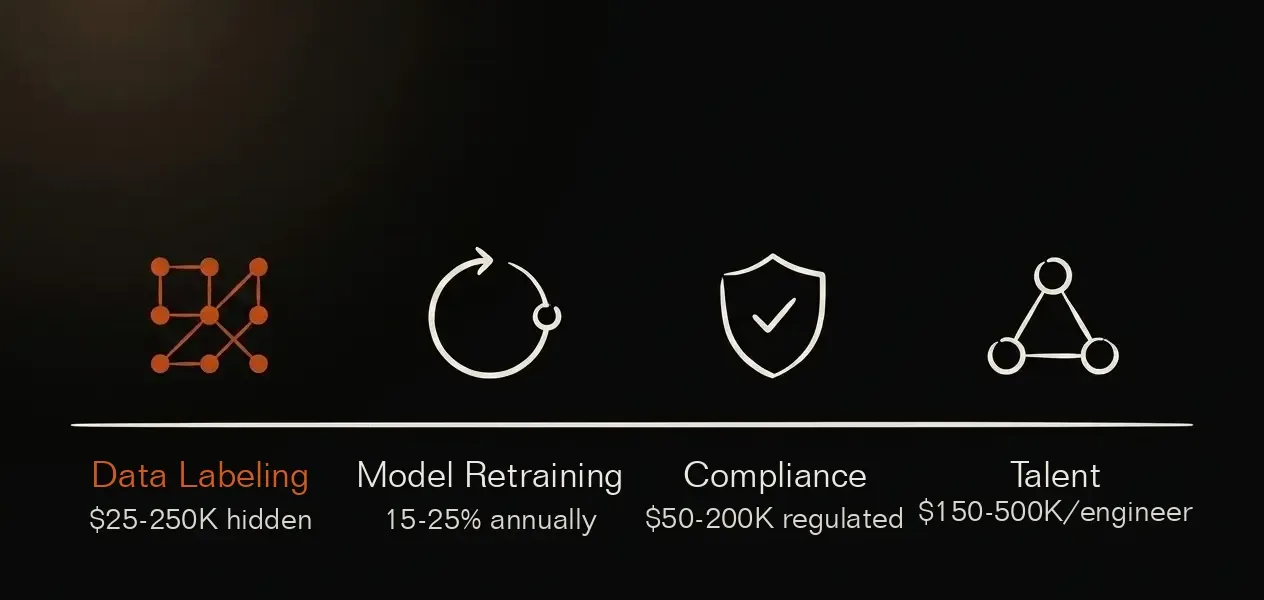
Data labeling seems cheap until you scale. Simple intent labels cost $0.05 each. Complex entity extraction with context runs $1-$5 per label. A production chatbot needs 5,000-50,000 labeled examples depending on domain complexity. At scale, you’re looking at $25,000-$250,000 in labeling costs that most quotes exclude. This is often the major cost driver nobody budgets for.
Model retraining consumes 15-25% of compute costs annually. User language evolves. Products change. Competitors introduce new terminology. Without regular retraining, accuracy degrades 2-5% per quarter. Budget $10,000-$50,000 yearly for retraining cycles on custom AI models.
Compliance certification adds six-figure costs for regulated industries:
- SOC 2 Type II certification: $50,000-$150,000 initial cost, $30,000+ annually
- HIPAA compliance for healthcare chatbots: $35,000-$60,000
- PCI DSS for payment-handling bots: $50,000-$200,000
- GDPR data processing audit: $20,000-$50,000
Talent costs create the largest hidden multiplier. Entry-level AI engineers command $150,000-$200,000 annually in 2026. That’s entry-level. Senior practitioners (7-10 years) reach $300,000-$500,000. Turnover costs 50-60% of annual salary in recruiting and ramp-up time. Every three developers on a dedicated development team need one dedicated support engineer for system maintenance. Cross-functional coordination consumes 14 hours weekly per initiative.
The connection between these costs and the 85% failure rate is direct. Organizations budget for the platform quote. They skip data preparation. They understaff the chatbot project. Eighteen months later? Their AI chatbots answer questions incorrectly 40% of the time. Fixing a broken deployment costs 3-5x more than building correctly from the start.
Industry-Specific Chatbot Development Costs
The overall cost of chatbot development varies dramatically by vertical because compliance, integration complexity, and user expectations differ.
Healthcare chatbots run $80,000-$350,000 or higher. HIPAA compliance alone adds $35,000-$60,000 to the initial cost. EHR integration (Epic, Cerner, or similar) costs $30,000-$60,000 because these systems weren’t designed for chatbot connectivity. Different architecture. Different era. Symptom triage logic requires clinical validation at $45,000-$80,000. A healthcare organization deploying patient-facing AI without proper compliance faces penalties up to $1.5 million per violation under HIPAA.
Financial services pay a 25-35% premium for security requirements. Encryption implementation costs $25,000-$50,000 for setup plus $2,000-$3,000 monthly. Fraud detection AI integration runs $40,000-$75,000 initial plus $3,000-$4,000 monthly for AI model updates. Expensive. Regulatory audit trails add $15,000-$30,000 annually. A banking chatbot handling transactions rather than just queries easily reaches $850,000 for enterprise deployments with biometric authentication.
E-commerce implementations range $50,000-$150,000 annually for mid-market retailers. Product catalog integration costs $15,000-$40,000 depending on SKU count and catalog complexity. Cart recovery and checkout assistance add $20,000-$50,000. Inventory complexity matters too. Real-time inventory queries require API development at $10,000-$25,000.
B2B SaaS typically runs lower overall AI chatbot development cost: $25,000-$100,000 for customer support chatbots integrated with existing documentation. The simpler compliance environment and well-structured knowledge bases reduce development costs. But enterprise sales assist bots that integrate with Salesforce, pull real-time pricing, and handle complex multi-stakeholder conversations approach $200,000.
One pattern holds across verticals: regulated industries don’t just pay more upfront. They pay more continuously. Healthcare and financial services chatbots require quarterly compliance reviews, annual recertification, and real-time monitoring that adds $50,000-$100,000 annually beyond standard development and maintenance costs.
The compliance trap:
Organizations often discover compliance requirements after starting development. A fintech startup building a customer service chatbot assumes it’s a simple support tool. Then legal flags that any conversation touching account balances requires PCI DSS certification. The $40,000 project becomes $140,000 overnight. Due diligence on compliance requirements before selecting an approach saves 6 figures in change orders.
Industry-specific integration complexity:
Healthcare EHR systems (Epic, Cerner, Allscripts) weren’t built for real-time chatbot queries. They use batch interfaces, require specialized authentication, and have API rate limits that force architectural compromises. A chatbot that needs patient appointment data may wait 15-30 seconds for an EHR response. Unacceptable for conversational UX. Building a caching layer adds $20,000-$40,000 to handle this latency.
E-commerce product catalogs present different challenges. Fifty thousand SKUs. That’s what mid-market retailers typically carry—and each one needs structured data that chatbots can search and filter. “Show me red dresses under $100 in size 8” requires semantic understanding and structured product data integration. Catalog search optimization adds $15,000-$35,000 to basic chatbot cost.
The Build vs. Buy vs. Rent Decision Framework
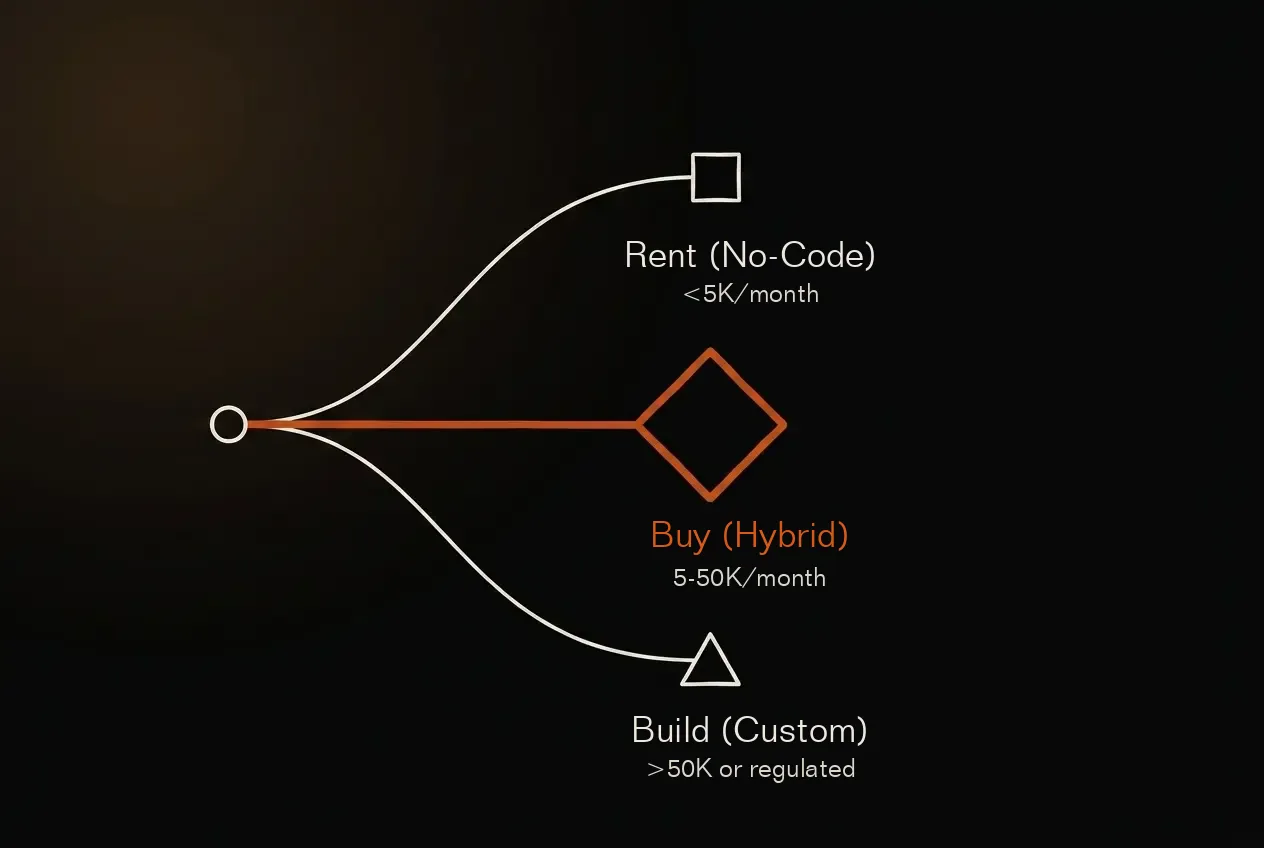
The wrong question is “how much does a chatbot cost?” The right question is “which approach fits my volume, complexity, and timeline?” Here’s the decision framework to figure out how much you should actually budget:
Rent (No-Code Platform): <5,000 conversations/month + standard use case
Choose no-code when your chatbot use cases match what platforms already do well: FAQ automation, appointment scheduling, lead qualification, basic support triage. Simple stuff. Monthly cost: $50-$500. Time to deploy: 2-4 weeks. Chatbot ROI timeline: 30-60 days to see initial value.
Best fit: SMBs with straightforward customer support needs, companies testing chatbot adoption before larger investment, teams without ML expertise.
Red flags for no-code: conversation volumes exceeding 10,000 monthly (costs spike), need for custom integrations beyond standard connectors, industry-specific compliance requirements not covered by the platform.
Buy (Hybrid): 5,000-50,000 conversations/month + integration requirements
Choose hybrid when you need platform infrastructure but require custom integrations or workflows the chatbot platform doesn’t support natively. Setup cost: $10,000-$50,000 plus platform subscription. Time to deploy: 2-4 months. ROI timeline: 4-8 months.
Best fit: mid-market companies with existing tech stacks requiring AI integration, teams that want vendor-managed AI infrastructure but need customization, organizations scaling from no-code that hit platform limits. An experienced chatbot development company can cut hybrid implementation timelines from 4 months to 6-8 weeks.
Red flags for hybrid: regulatory requirements the platform can’t certify against, conversation volumes exceeding 100,000 monthly, chatbot as core product feature rather than support tool.
Build (Custom): >50,000 conversations/month OR regulated OR core product
Choose custom when scale economics favor it, when compliance requires end-to-end control, or when the chatbot is part of your product rather than an operational tool. Development cost to build an AI chatbot: $75,000-$500,000+. Time to deploy: 6-12 months. ROI timeline: 8-14 months.
Best fit: enterprises with high volume where per-conversation costs dominate, regulated industries requiring audit trails, and companies where AI-powered conversation is a market differentiator. Scale matters.
The break-even math: custom development makes financial sense when monthly conversation volume exceeds 50,000 AND you plan to operate for 3+ years. Below that threshold, the upfront development cost rarely recovers versus platform subscription. Above it, per-conversation API costs plus owned infrastructure beats platform per-seat or per-conversation fees. Total AI investment over three years determines the right path, not year-one cost alone.
The migration trap:
Starting with no-code and “upgrading later” sounds reasonable. But migrations are expensive. Moving from a no-code platform to custom development means:
- Extracting conversation history (if the platform even exports it): $5,000-$15,000 in data engineering
- Rebuilding intents and training data: $10,000-$30,000 in labeling and validation
- Re-integrating systems with new architecture: $20,000-$50,000. More if complex.
- Retraining users: $5,000-$15,000
- Parallel running period to validate: $10,000-$25,000 in dual platform costs
Total migration cost: $50,000-$135,000. That’s on top of whatever you spent on the original platform. Organizations that anticipate crossing the 50,000 conversation threshold within 24 months should start with hybrid or custom despite the higher upfront cost. Paying $100,000 for a custom build beats paying $40,000 for no-code plus $100,000 to migrate plus another $100,000 for the custom system.
Volume projection discipline:
Accurate volume forecasting requires historical data most organizations don’t have when launching their first chatbot. Conservative approach: assume 5% of your current support tickets will route to the chatbot in month one, growing 10-15% monthly as users adopt and you expand capabilities. A company handling 10,000 support tickets monthly should plan for 500 chatbot conversations in month one, 5,000 by month six, and 15,000 by month twelve. Build the decision framework around where you’ll be at month 18, not month one.

What Your RFP Should Actually Ask
Vendor quotes hide total cost. Your request for proposal needs questions that expose the full picture and help you understand the cost of building a chatbot for your business:
Data preparation ownership:
- Who provides training data? What format?
- Who labels intents and entities?
- What’s the minimum dataset size for acceptable accuracy?
- What’s the cost depends on if you need the vendor to prepare data?
Integration scope:
- Which integrations are included in the cost estimate?
- What’s the per-integration cost for additional systems?
- Who maintains integrations when target APIs change?
- What’s the SLA for integration-related issues?
Retraining and maintenance:
- How often does the AI model retrain?
- What triggers a retraining cycle?
- Who pays for compute during retraining?
- What’s the monthly/annual maintenance cost?
Compliance responsibility:
- Who holds compliance certifications?
- What audits has the chatbot platform passed?
- Who’s liable for compliance violations?
- What’s the cost of chatbot compliance certifications?
Scale economics:
- What’s the per-conversation cost at 10K, 50K, 100K monthly volume?
- What volume triggers tier upgrades?
- What’s the cost ranges at each tier?
- Are there volume discounts available?
Get these answers in writing before you sign. Vendors who can’t answer clearly either haven’t thought through their pricing model or are intentionally obscuring costs. Both are red flags.
Red flags in vendor responses:
- “Our platform handles all data preparation” — Ask: what training data do you start with? If they can’t show you an existing dataset relevant to your domain, you’re building training data regardless.
- “Integrations are included” — Ask: which specific systems, and who builds the connectors? Standard integrations (Slack, Zendesk) are often included; custom integrations rarely are.
- “Maintenance is minimal” — Ask: what’s the retraining cadence? Any honest vendor retrains monthly at minimum. Quarterly retraining means degraded accuracy.
- “Unlimited conversations” — Ask: at what API tier? Unlimited at GPT-4o pricing ($10/million output) means something different than unlimited at GPT-4o-mini ($0.60/million).
Negotiation leverage:
Annual prepayment typically gets 15-25% discount on subscription platforms. Committed conversation volumes unlock lower per-conversation rates. Multi-year contracts can cut costs 20-30% but create lock-in risk. The optimal negotiation positions depends on your volume confidence. Uncertain volumes favor monthly billing despite higher unit costs.
Understanding the AI Chatbot Development Cost Reality
The organizations that run successful chatbot deployments share one trait: they budget for the three-year cost from day one, not the year-one quote. A $50,000 vendor quote with honest TCO planning becomes a $150,000-$200,000 chatbot project. Starting with that number, rather than discovering it 18 months in, is the difference between a chatbot that delivers ROI and one that gets quietly sunset after disappointing everyone.
We used to recommend that clients start with the cheapest viable option and upgrade later. We stopped after seeing three consecutive projects where “upgrade later” meant “rebuild entirely at 3x the original budget” because the initial platform couldn’t scale past 10,000 monthly conversations. The cost to develop an AI chatbot that scales is higher upfront but dramatically lower over three years.
The chatbot can cost anywhere from $5,000 to $500,000. But much does it cost in your specific situation? That depends on conversation volume, integration complexity, compliance requirements, and whether you’re building a support tool or a product feature. Map your requirements to the framework above, build in 25-40% for data preparation that vendors won’t quote, and plan for 15-25% annual maintenance.
Every chatbot project that fails does so for predictable reasons: underestimated data costs, integration surprises, or talent gaps. Every chatbot project that succeeds budgeted for those realities from day one.